In May 1952 a bear drowned in Wielki Staw Polski when the spring ice gave way under its weight. Shelter staff recovered the carcass, which can now be seen in the Tatra Museum in Zakopane. It is a detail that says a lot about the Valley of the Five Polish Ponds (Dolina Pięciu Stawów Polskich): a high-altitude place, with ice even when the season has already turned down below, and a name that promises five lakes when there are six.
Six lakes in a hanging valley
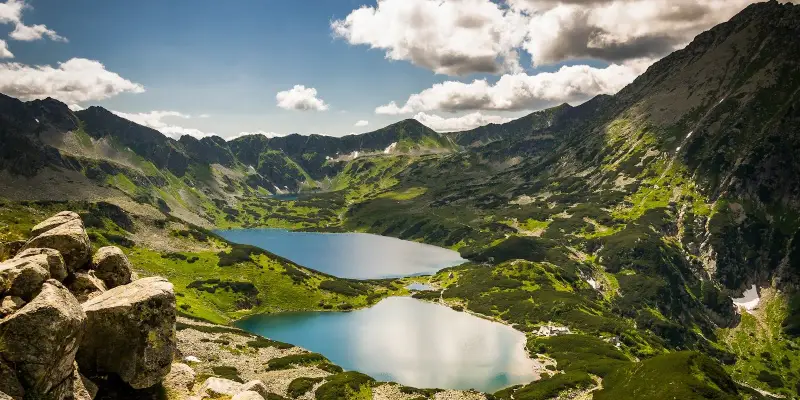
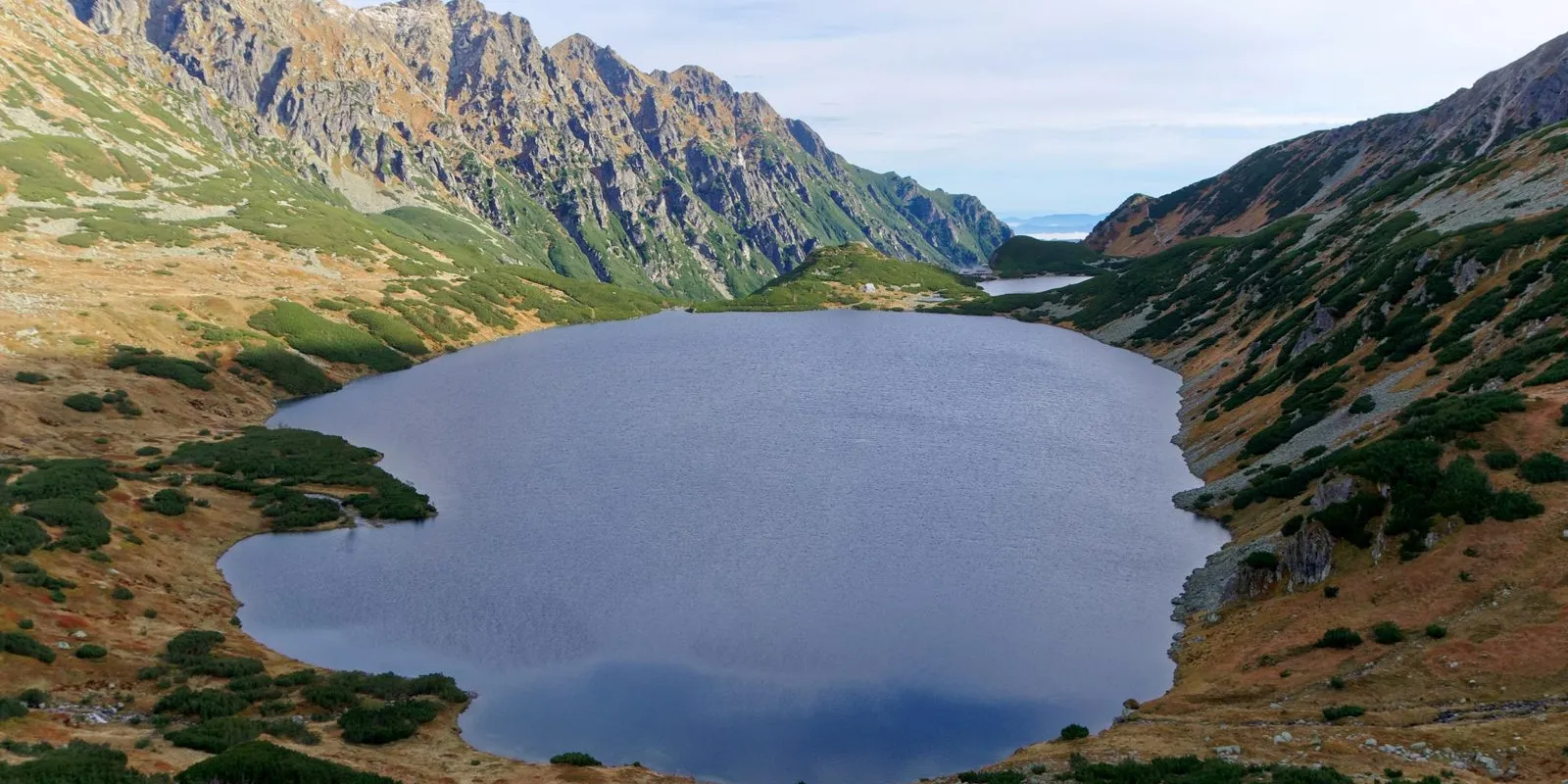
The lakes are Wielki, Zadni, Czarny, Mały, Przedni and Wole Oko, covering about 61 hectares of water in all. Wole Oko, the smallest, is seasonal. The valley lies in the High Tatras, entirely inside the national park, between 1,625 and 1,900 m: it is about 4 km long and 2 km wide, glacial in origin, a hanging stretch above Dolina Roztoki with a sickle-shaped floor carved by ice.
Wielki Staw, at 1,665 m, measures about 34 hectares and is roughly a kilometre long; it is nearly 80 m deep and with some 13 million cubic metres of water it holds the greatest volume of any Tatra lake. It formed in the Pleistocene where several glaciers met and is closed off by a moraine. For most of its history it had no fish; then, probably in the 1980s, brook trout were illegally introduced.
The Siklawa and the wall of the lakes
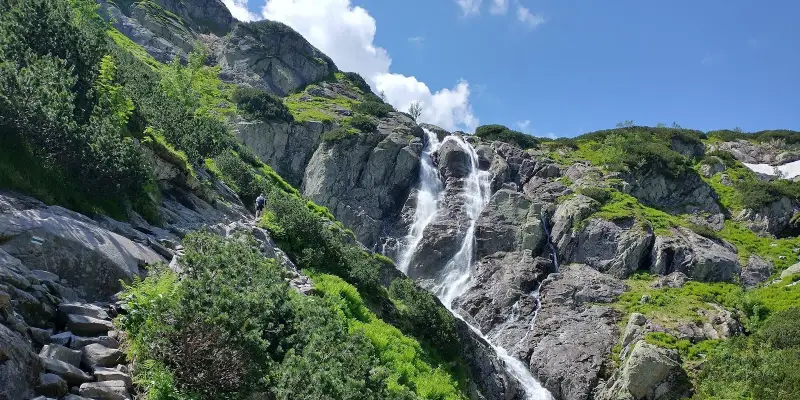
From Wielki Staw the Roztoka stream flows out and throws itself down the wall known as the ściana stawiarska, which separates the lake valley from Dolina Roztoki. That drop is the Siklawa, a stepped waterfall about 70 m high falling in two or three jets depending on the lake level. It is the tallest waterfall in Poland; the Tatras hold a taller one in Slovakia, the Ciężka Siklawa. The flow changes a lot with the seasons: after rain or in the thaw it is full and loud, in dry spells it shrinks to thin threads on dark rock.
The trail climbs the wall over stretches of rock smoothed by glaciers, which can be slippery and dangerous when wet, icy or snowy. It is not a walk to take lightly.
Getting there: two routes, one long day
From below you climb through Dolina Roztoki, from Wodogrzmoty Mickiewicza, on the green trail: about 2 h 05 min up to Wielki Staw (1 h 40 min down), passing the Siklawa, and another 10 minutes to the hut. A variant, the black trail, branches off the green and leads to the hut. Alternatively you start at Palenica Białczańska, walk the paved road to Morskie Oko and then take the blue trail: about 2 h from the lake to the hut, 1 h 40 min on the way back.
Anyone coming by the Morskie Oko road has to add the asphalt, the climb and the return: that makes the full outing a long, tiring day, to be planned so that you are back in daylight. A sensible idea is to go up one way and down the other, if logistics allow. Walkers who are not in training would do better to stop at the Siklawa or at Morskie Oko.
The hut, the shepherds and the victims of winter
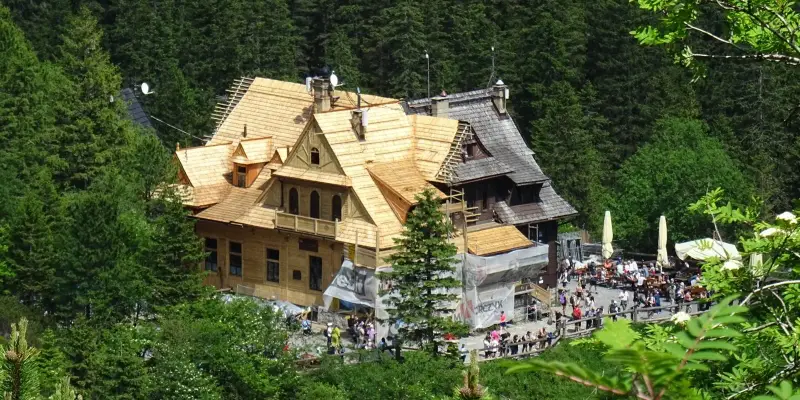
The valley was part of Hala Pięć Stawów, where shepherds from Białka brought their flocks; near Wielki Staw stands a stone shepherds' hut, the oldest in the Tatras, from the 17th century. Grazing ended when the area passed to the park; cows came up until 1968. Huts have followed one another in four editions: a stone one in 1876, a wooden one in 1898, a larger one that burned in 1945, and the present one, built after the war above Przedni Staw and named after Leopold Świerz, the highest in the Polish Tatras (1,671 m).
The hut is a base, not a guarantee: in March 1976 two hikers died of exhaustion a few metres from the hut during a snowstorm. From here routes lead to Zawrat, Kozi Wierch and Krzyżne, to be tackled only in stable conditions.
What to look at and when to go
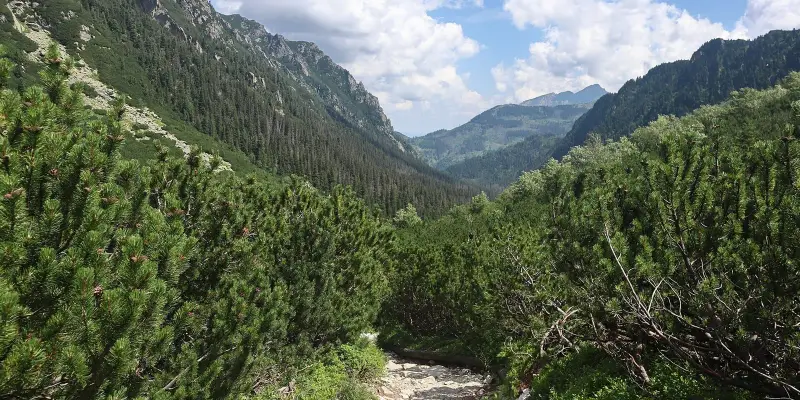
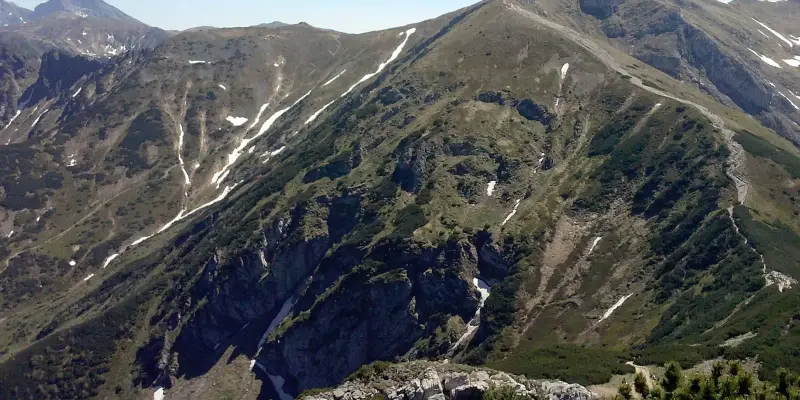
Around the lakes grow mostly dwarf pine and alpine vegetation, with a single larch near Wielki Staw; brown bear, Tatra chamois, marmot, deer and lynx live here. Look at the walls above the lakes, at Przedni Staw below the hut, at how the main lakes sit on different steps. In spring and early summer snow and ice can linger, and in winter the avalanche danger is real: check the TOPR bulletin and park notices before setting out, because trails can be closed.
Hiking shoes, warm layers, a rain jacket and a headlamp are the minimum. In an accident call 112 or TOPR on 985.
Frequently asked questions
Why is it called five ponds if there are six?
Because the sixth, Wole Oko, is the smallest and seasonal, so the name counted five. The others are Wielki, Zadni, Czarny, Mały and Przedni Staw, covering about 61 hectares of water in total.
Is the Siklawa the tallest waterfall in the Tatras?
No, it is the tallest in Poland, at about 70 m. The overall record in the Tatras belongs to the Ciężka Siklawa on the Slovak side, in the Biała Woda valley.
Can you walk to the lake valley in snow?
Only with care and up-to-date information. Snow and ice can linger late in the season, and in winter avalanche danger is real: the park can close some trails. Check the TOPR bulletin before you decide.
Are there fish in the lakes?
Yes, brook trout live in Wielki Staw, but they are not native: they were illegally introduced, probably in the 1980s. For most of its history the lake had no fish.