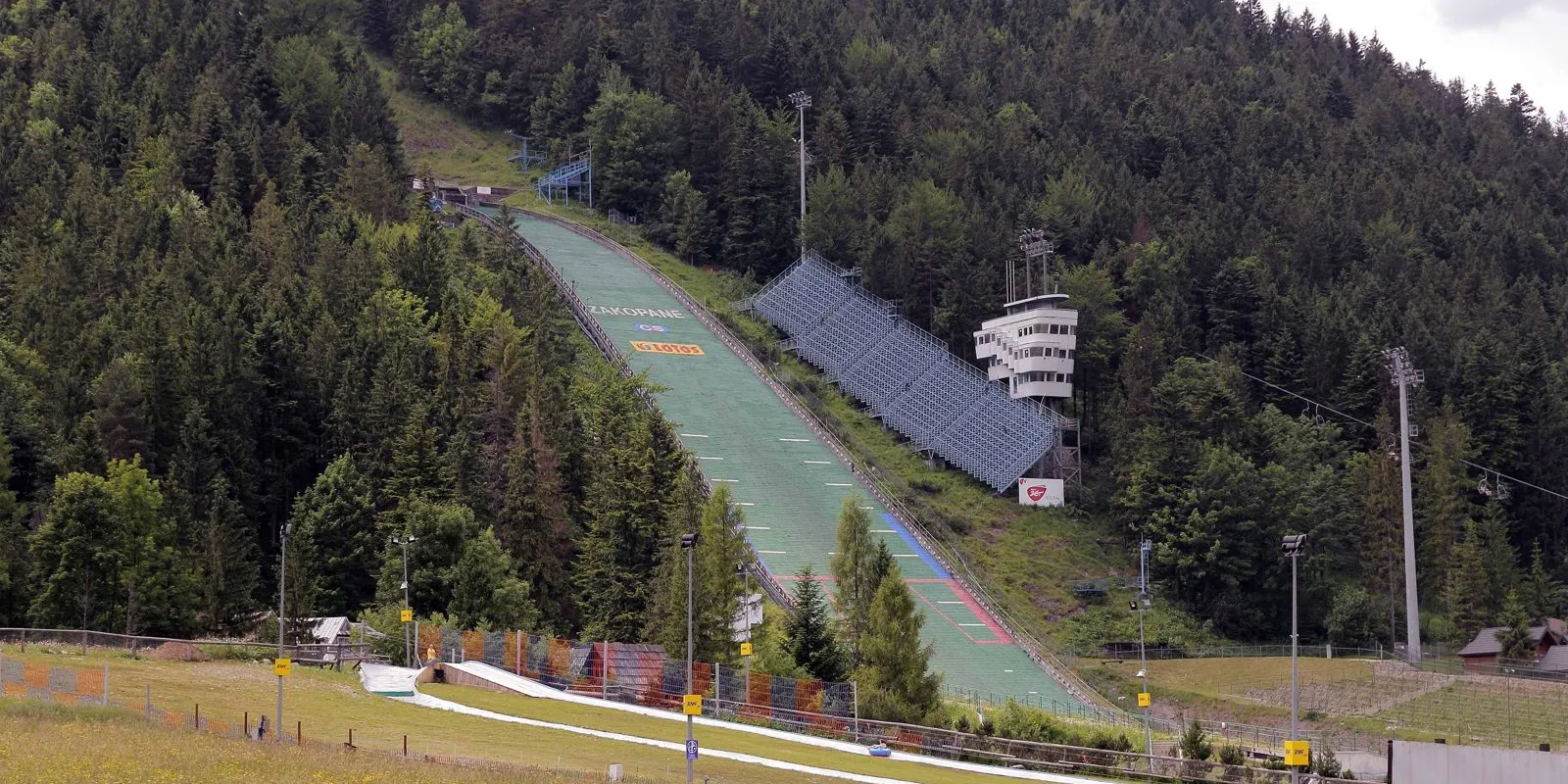
At the 1962 Nordic World Ski Championships, about 120,000 people gathered on the slope of Wielka Krokiew. It remains the attendance record for a competition on the Krokiew, a crowd that no event could match today for safety reasons. That figure alone explains what the hill means to Zakopane: not just a sports venue but a place where the town looks at itself, and where skiing in Poland found its home.
A hill with a century of history
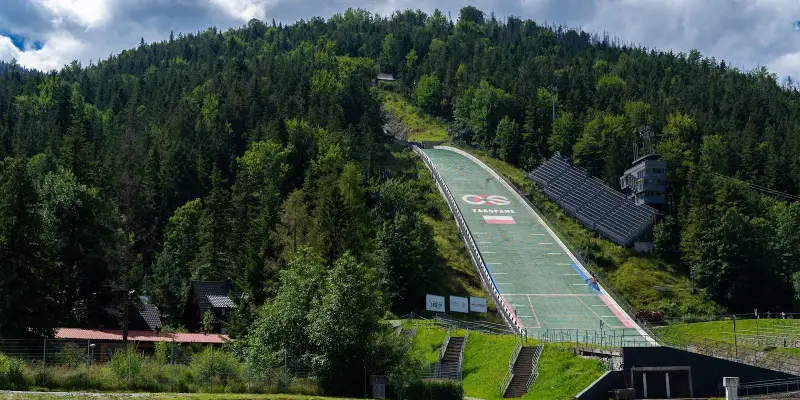
The Wielka Krokiew, the Great Krokiew, opened in 1925 and was designed by the engineer Karol Stryjeński. It has been rebuilt more than once, most recently in 2016–2017. After that rebuild it has a K-point of 125 metres and a hill size of HS140; the official record is 147 metres, jumped by Yukiya Satō in 2020.
The hill is visible from the town and dominates its slope: anyone arriving in Zakopane spots it easily, tall and steep like a ramp from another age. Walking at its foot in summer is a different experience from a winter competition, but even so you grasp its scale.
One name, two patrons, a story of war
Since 1989 the hill has carried the name of Stanisław Marusarz, a great ski jumper and, during the war, a courier. Before that its patron was Stryjeński, its designer. Marusarz is a figure who condenses the character of Zakopane: an extraordinary athlete between the wars, who under the occupation put himself at the service of the Resistance, carrying messages across the mountains and using precisely his knowledge of the slopes and paths. His sister Helena Marusarzówna, a skier, was also involved in the underground and paid with her life.
The history of skiing in Zakopane cannot be understood without remembering that here sport and mountains were the same thing. The same men who jumped from the hill knew the gullies, carried messages and guided walkers. That overlap explains why the champions of this land are still treated almost as family.
From World Championships to World Cup
Zakopane hosted the Nordic World Ski Championships in 1929, 1939 and 1962, three editions that marked the growth of the place. Since 1980 the ski jumping World Cup has stopped in Zakopane. Every winter, when the World Cup circus arrives, the area around the hill becomes a festival of white-and-red flags, drums and chants, the slope filling up and the whole town following the event.
Polish jumping champions have a special place in the local imagination. Besides Marusarz, people remember Bronisław Czech, a skier from Zakopane who died during the war, and in more recent times Kamil Stoch, born in the town and a protagonist at the top of world jumping. Beside him, Adam Małysz, from Wisła but revered across the country, turned ski jumping into a national sport, with a popularity that filled town squares in front of screens.
How to experience the Krokiew as a visitor
Watching a live competition is the strongest experience: stadium atmosphere, cold, jumps that seem to challenge physics. It needs planning ahead, because during events the town fills up and beds run short; the calendar changes every year, so it pays to check. Outside competitions you can still walk up to the foot of the hill to look at it close up and take a few photos: the size is easier to feel from below.
For families with children the hill is a short, spectacular stop; for winter-sport fans it is almost a pilgrimage. In winter dress in layers, because wind can be felt on the slope, and bear in mind that access changes during competitions. If you have more time, complete the visit with the Tatra Museum, for the story of the mountains, or a day on the slopes of Kasprowy Wierch, where skiing continues in its everyday form.
What a ski hill stands for
Wielka Krokiew tells more than it seems: early twentieth-century engineering, the memory of a wartime courier, the fever of a crowd filling a hillside. It is a place where sport stops being entertainment and becomes collective memory. Someone looking at the hill from afar sees a white ramp in the forest; someone who stops to think about who has flown over it sees a page of Polish history written in snow.
Frequently asked questions
Can I go up the Wielka Krokiew hill?
It depends on the period: access to the tower and slope varies with the season and events under way. You can always walk up to the foot of the hill and see it close up. It is wise to check locally or with the venue.
How do I get to Wielka Krokiew from the centre?
From the centre of Zakopane you can walk, a slightly uphill stroll, or take a short bus or car ride. During competitions parking is limited, so it is better to go on foot or by public transport.
What do K125 and HS140 mean?
They are measurements used in ski jumping: the K-point (125 metres) is the critical point of the landing area, while HS (140) is the hill size, where the landing profile ends. Together they classify hills and let them be compared.
Who is Kamil Stoch?
Kamil Stoch is a ski jumper born in Zakopane and one of the most decorated in Polish sporting history. He is much loved in his home town, where crowds follow him with enthusiasm when he competes at Wielka Krokiew.