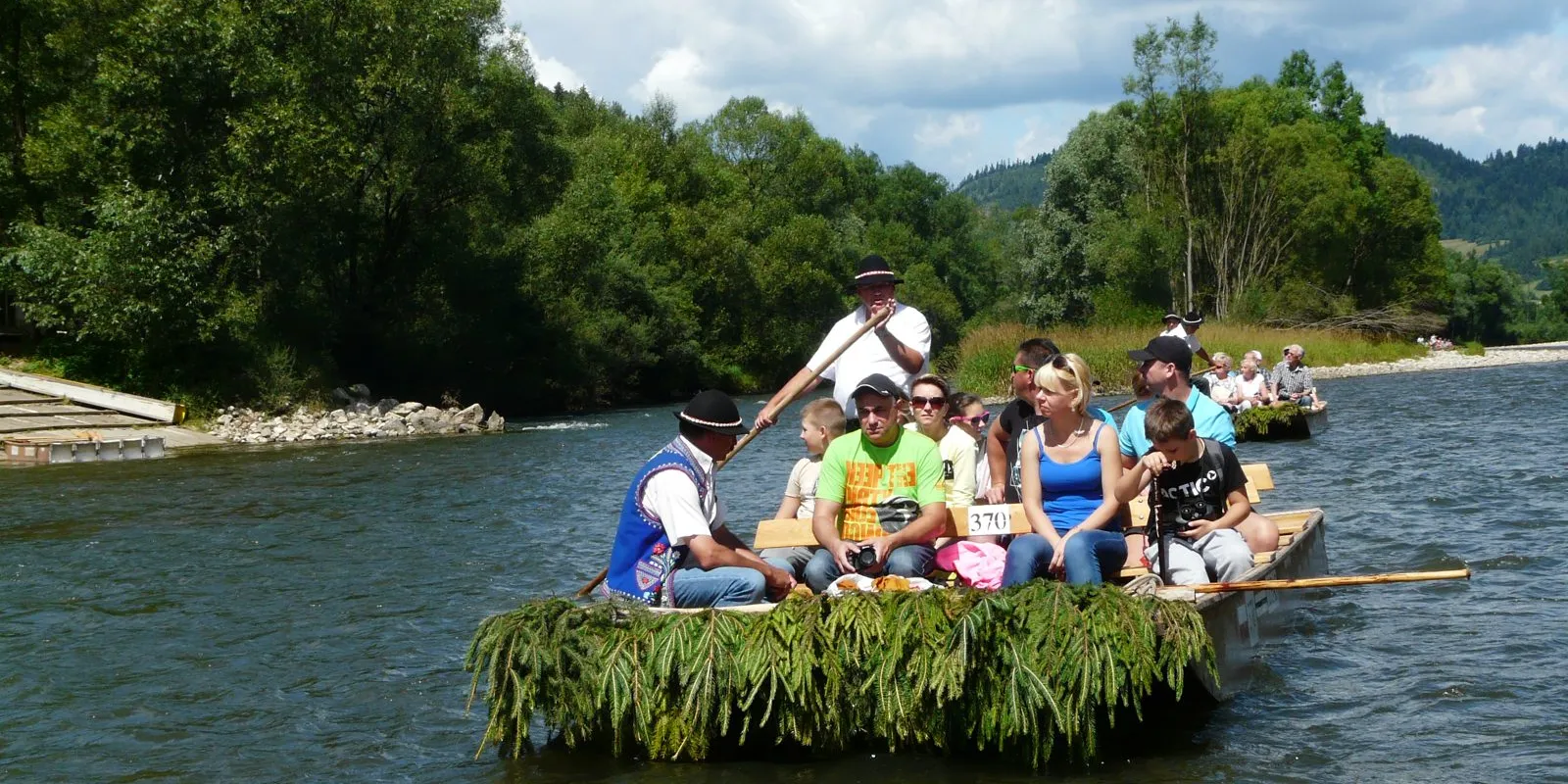
The rafts on the Dunajec have no engine and no real oars: they are timber craft lashed together and steered by two men with long poles, highlanders in hats and traditional dress. Watch them at work and you quickly understand that the trip is more a story than an adventure. As the current carries the raft between cliffs of pale limestone, the boatmen point out rocks, recount legends and, with a certain irony, tease their passengers. It is slow and quiet, a perfect day away from the Tatras.
What Dunajec rafting really is
Let us clear up a misunderstanding first: this is not whitewater rafting. There are no rapids and no inflatable-boat adrenaline. The traditional rafts are built by joining several wooden canoes, and the classic route runs through the Dunajec Gorge, where the river cuts its way through the rocks of the Pieniny, partly along the border with Slovakia. The pleasure is the landscape: the slow bend of the cliffs, forest running down to the water, birds of prey over the ridges.
It suits almost everyone: families, older travellers, people who dislike effort. Anyone wanting action should look elsewhere. The season is the warm months, and water level and weather decide, so ask locally before you set off.
The route and what you see
The typical route starts at Sromowce Kąty and ends at Szczawnica, a spa town known for its mineral waters. Along the way are famous landmarks: the Sokolica cliff, with pines clinging to the rock, the profile of the Three Crowns, the best-known peak of the Pieniny, and, on the Slovak bank upstream of the gorge, the monastery of Červený Kláštor, often paired with the trip. The boatmen know every bend and name, and tell them in a mix of dialect and jokes that non-Poles partly miss, though the tone is contagious.
Do not carry too much: a waterproof jacket and shoes that can get wet are enough, and a life jacket is provided before boarding. A camera with a strap is better than a phone held over the water.
The castles: a natural extension of the day
If you have time, add a stop at the castles. On Lake Czorsztyn two fortresses face each other: Czorsztyn on one side and Niedzica on the other, each commanding the shore from a headland. They make a second stop that fits well between the rafting and the return, and give the outing a historical dimension beyond the scenery. Travellers with children will find the castles a way to break up the day.
An honest note: do not try to do everything. Rafting, castles and a stroll in Szczawnica in a single day means hours on the road and a rush. Choose two stops, not four.
From Zakopane to the Pieniny: planning the day
The Pieniny are a full-day trip from Zakopane, best done by car: the drive takes more than an hour, across Podhale and through Nowy Targ. Public transport is possible, but connections can be less convenient and it pays to check in advance, because a missed connection leaves you stranded in the middle of the valley. Those who do not drive can use organised excursions leaving from town, which often include the return.
The best plan is to leave early, which avoids queues at the raft departures and the return traffic. Leave a margin in the afternoon: if you plan to be back in Zakopane for dinner, build in a good safety buffer, especially in high season.
Who it is for, and who it is not
The Dunajec is ideal for people who have already seen the Tatras and want another face of the region, for those travelling with small children or elderly parents, and for days when the peaks are wrapped in cloud but the weather in the Pieniny is better. It is not for anyone who wants sport, absolute silence or a solitary experience: in the warm months the rafts leave one after another and the banks are busy. All told, it is a gentle day of scenery, voices and water that tests your patience more than your fitness, and leaves a surprisingly vivid impression of the southern Polish landscape.
And if you can choose, pick a sunny day with a little wind: the light on the pale limestone and the green of the water are the reason people still remember the rafts years later.
Frequently asked questions
Do you need to swim to do the Dunajec raft trip?
No, the current is slow and the boatmen steer the raft. A life jacket is provided before boarding and is worn throughout. If you are nervous about water, be reassured that the raft is stable and the route calm.
How long does the raft trip last?
The classic descent to Szczawnica generally takes a little over two hours, but plan on the whole day once you count the drive, the wait at departure and the return. The duration depends on the starting point, the water level and the stretch chosen.
Can you do it in winter?
No, raft descents run in the warmer months and depend on weather and river level. In winter you can still visit the castles and Szczawnica, but the river service is generally not available.
Do you need documents for the Pieniny trip?
An identity document is enough. The border with Slovakia follows part of the river, but the trip stays on the Polish side and there are no checks between the two Schengen countries. Still, always carry an ID with you.