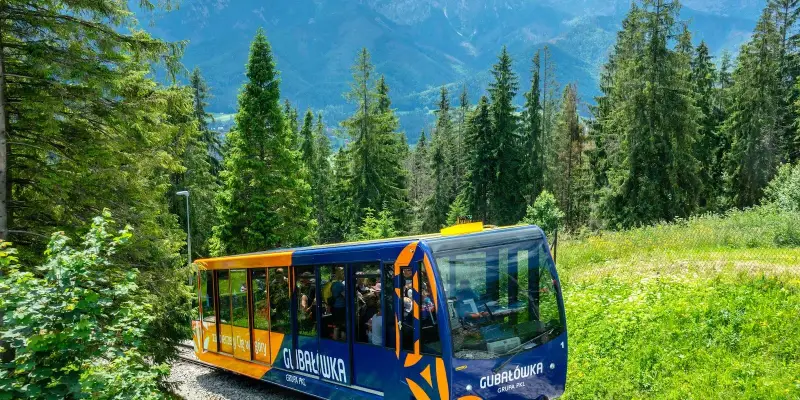
The Gubałówka funicular took only 168 days to build, with work starting in the summer of 1938 and the line opening on 20 December that year. It was the second of its kind in Poland. When its old rolling stock was retired in 2001, the material got a second life: it was used to adapt a former glider winch and build the Żar funicular at Międzybrodzie Żywieckie. Quite a story for a ride that almost everyone takes today with a phone in hand.
A short climb with the right window seat
The funicular links the lower station at 822 m with the upper one at 1,121 m, a rise of roughly 300 m in a few minutes. The two cars share a single track with a passing loop halfway, and since the modernisation completed in December 2001 they have glass roofs, so you can watch the Tatras while you climb. For the view, keep your eyes (and camera) ready for the whole ride: the Tatras open up as you gain height.
You can also walk up. Gubałówka lies outside the national park, so no TPN ticket is needed, and the path through forest and meadow makes a good warm-up for anyone with time and legs. Arriving on foot gives you a view you feel you earned, which is worth more than it sounds.
The panorama: what you see and when
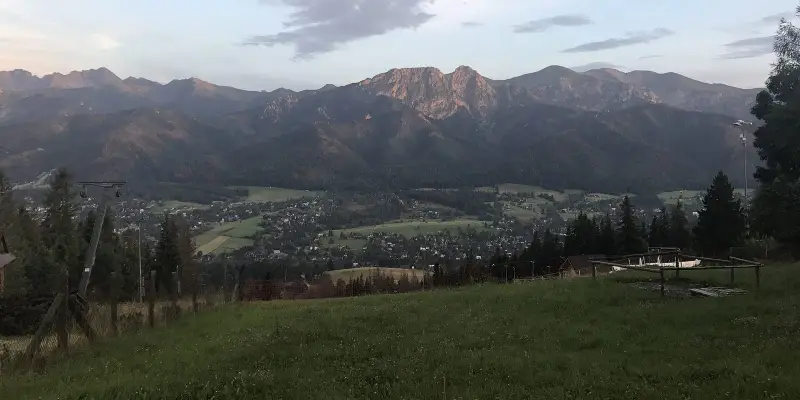
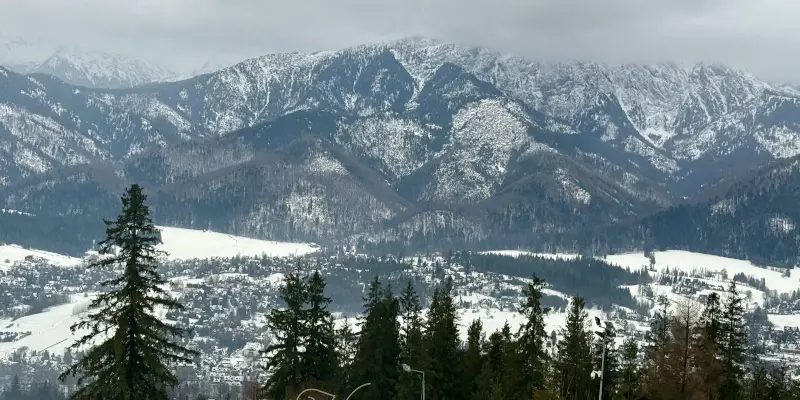
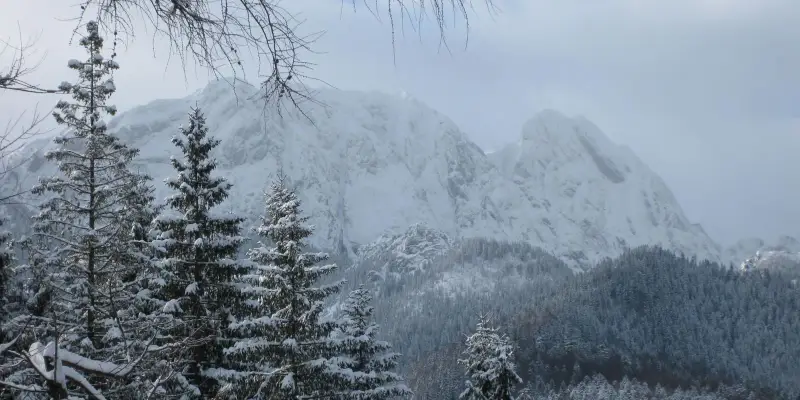
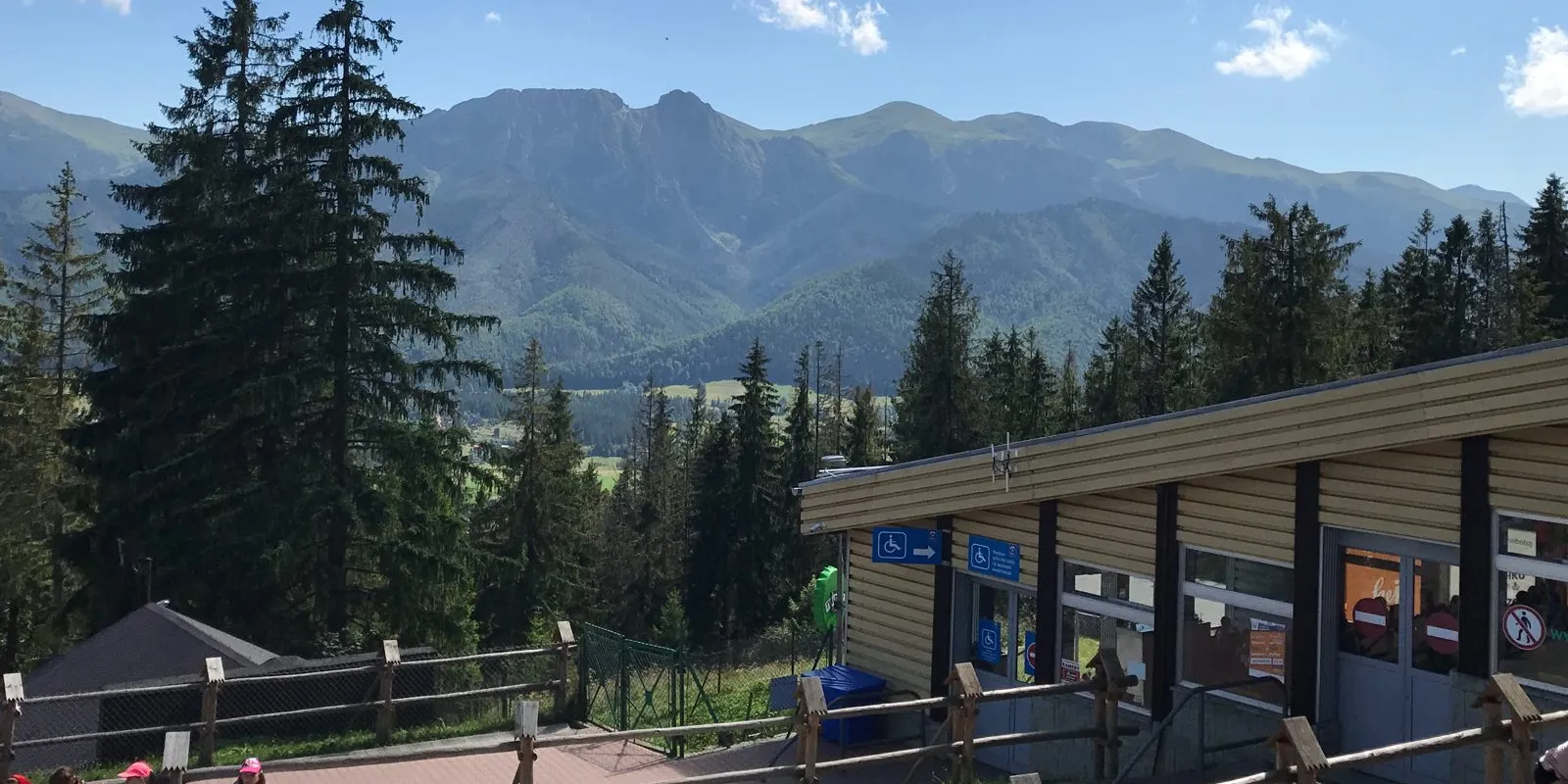
The hill stretches north-west of town, between about 1,120 and 1,129 m, in the Pogórze Gubałowskie. From the ridge the eye takes in the Polish Tatras, Zakopane at your feet, Podhale, the Pieniny, the Gorce and the Żywiec Beskids, including their Slovak parts. It is one of those spots where you grasp the region's geography at once: a wall of rock to the south and a spread of meadows to the north.
An honest warning: in cloud the panorama disappears, and the trip loses most of its point. Pick a clear day, ideally in the morning or toward sunset, when the light is softer and the crowds thinner. On a summer midday the arrival area is busy and loud, with stalls and music.
At the top: sculpture, mast and market stalls
On the ridge stand a 102 m radio and TV mast, RTON Gubałówka, and the Polonia Restituta sculpture. Around the upper station you meet the more touristy side of the mountain: stalls, restaurants and terrace bars. It is not a flaw to avoid at all costs but part of the experience, as long as you do not stop there. A few minutes of walking along the ridge leaves the bustle behind and brings you to stretches of meadow where the noise fades.
The ridge walk to Butorowy Wierch
The real reward lies in moving. From the summit the Papal Trail leads to Butorowy Wierch at 1,160 m, where a chairlift descends to Kościelisko. The ridge path is a gentle up-and-down through meadows and copses, with the Tatras on your left if you walk west. I cannot promise it is always in perfect condition: after rain or snow the ground can be muddy or icy, so hiking shoes and local information count for more than optimism.
It is a half-day outing, suited to people who want to walk without tackling the altitude of the national park. Remember that the last descent by chairlift or other transport follows seasonal timetables, so plan your return before going too far.
Walking down: the other half of the trip
Many people ride up and walk down, and it is the best combination. The descent toward town passes through meadows and timber houses, with Zakopane slowly growing larger and Giewont ahead. Wear shoes with good grip, because steep stretches can be slippery, and with snow on the ground the descent needs more care. If your knees are delicate, keep the funicular for the way back.
On the order of things, walking up and riding down is less common but has an advantage: you reach the top early, with fewer people, and tired legs get a comfortable ride home.
Who it is for, and who it is not
Gubałówka suits people short on time, families, anyone who wants a postcard view without a real hike, and days when the park's peaks are wrapped in cloud while the valley is clear. It is not the place for absolute silence or wild mountain terrain: the crowds in high season and the bars along the ridge give it the character of a popular viewpoint rather than a summit. If that is what you want, it offers one of the most recognisable views of the Tatras; otherwise, look to the valleys of the national park.
Frequently asked questions
How long does the funicular ride take?
A few minutes: the line covers about 300 m of height between the lower station at 822 m and the top at 1,121 m. The cars have glass roofs. The wait at the station in peak hours is what really takes time, so go early.
Do you need a national park ticket to walk up?
No. Gubałówka lies outside Tatra National Park, so walking it needs no TPN ticket. Normal common sense on paths still applies, and out of season the trail can be muddy or icy.
Is it suitable for children and pushchairs?
The funicular suits children, and the top has flat areas to stroll. On the trail to Butorowy Wierch the surface varies and can be muddy after rain, so a sturdy stroller does better than a city one. Walking down is for children used to hiking.
How do you reach Kościelisko on foot from the summit?
Follow the Papal Trail to Butorowy Wierch at 1,160 m, where a chairlift descends to Kościelisko. It is the simplest way to finish the ridge traverse without retracing your steps, and it connects well with the Kościeliska valley.