Town itinerary
Churches, villas and timber architecture
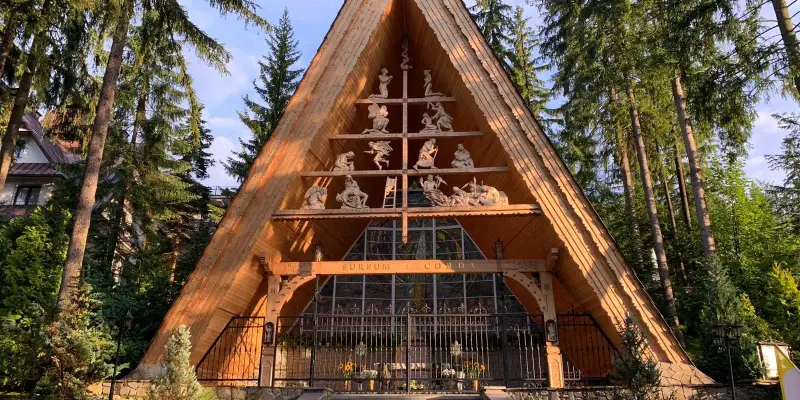
In the foundations of the Fatima shrine they placed a rosary and a photograph of John Paul II, and under every foundation brick a Miraculous Medal. From that detail begins a route through five places in and around Zakopane: a national shrine, a workshop-villa, an old church with its cemetery, a villa-and-park complex, a mountain chapel. They are tied together by the town’s history and by the style Stanisław Witkiewicz invented from the houses of the highlanders.
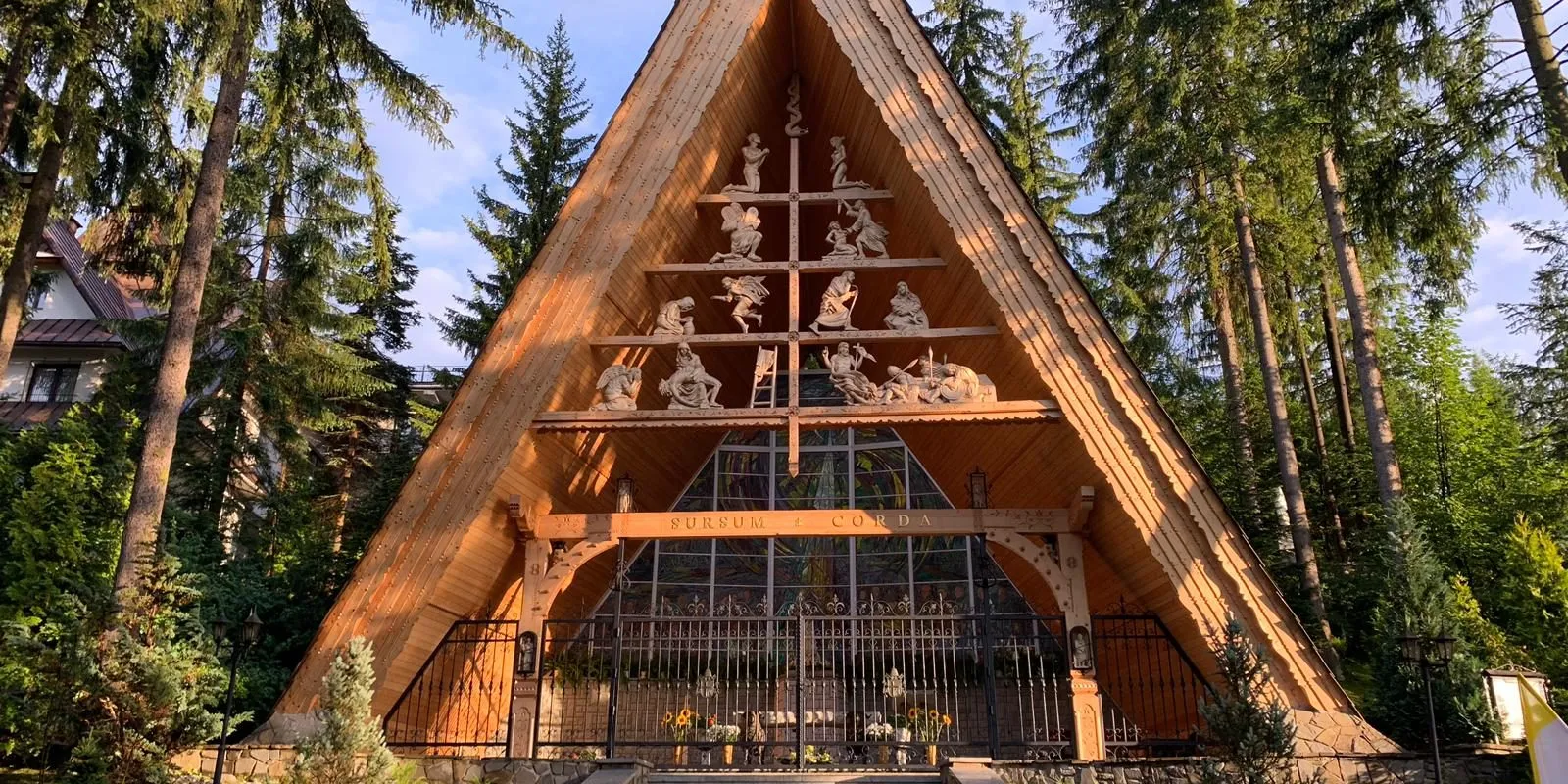
The Shrine of Our Lady of Fatima was built between 1987 and 1992 as an ex-voto for the survival of John Paul II after the assassination attempt of 13 May 1981, to a design by Stanisław Tylka; the Pope himself consecrated it on 7 June 1997. A bell donated by him rings in the bell tower, and in the Park Fatimski stands the papal altar of the 1997 Mass. The shrine is run by the Pallottine fathers.
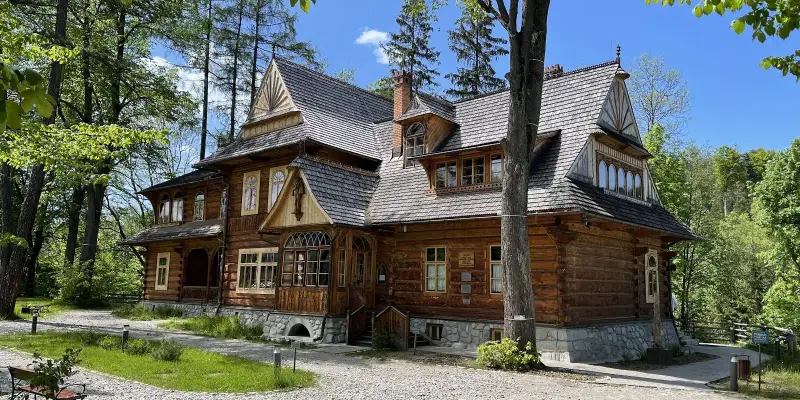
Villa Koliba, today the Museum of the Zakopane Style, was designed by Witkiewicz in 1892–93 and built by local highlanders under his supervision: it was the first house in the Zakopane style, the workshop from which the language of carved beams and steep roofs spread across the town. Since 4 December 1993 it has housed the museum, a branch of the Muzeum Tatrzańskie, with furniture and interiors from the golden age of the style. It helps you grasp how a “national” architecture was born before you meet its variations in the streets.
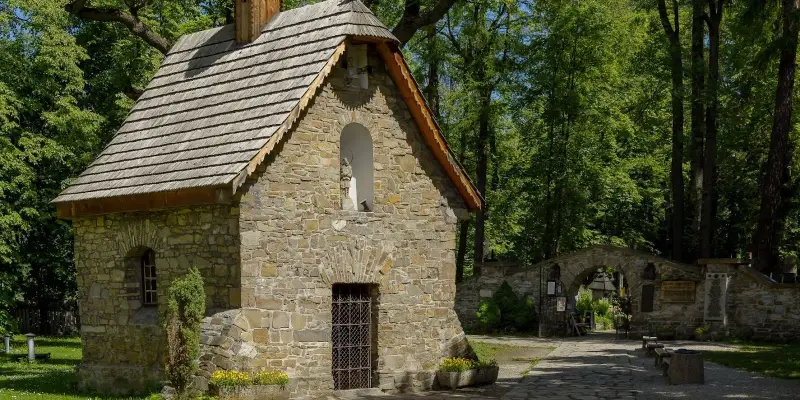
The old wooden shrine of St Clement was built between 1847 and 1851 with funds from Klementyna and Edward Homolacs, under the carpenter Sebastian Gąsienica Sobczak: a single-nave church with three altars and a shingle roof. Beside it stands the stone chapel of St Andrew, consecrated in 1801. Behind the church lies the Pęksowy Brzyzek cemetery, where Tytus Chałubiński, Jan Krzeptowski Sabała and Kornel Makuszyński rest, and where the ashes of Witkiewicz, Orkan and Tetmajer were moved; there is also the symbolic grave of General Mariusz Zaruski, whose burial place is unknown.
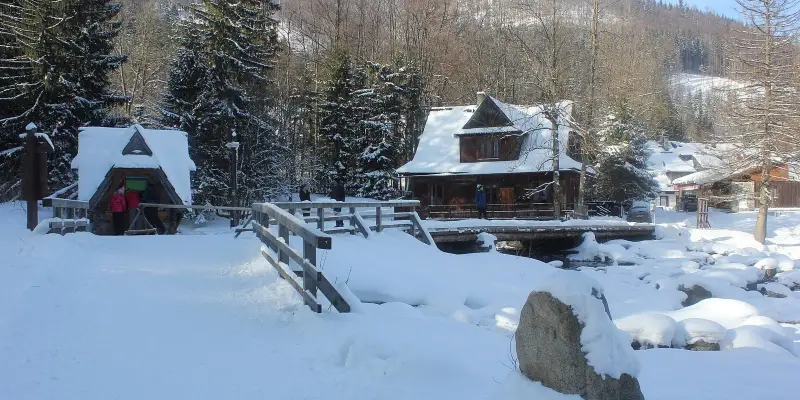
The villa-and-park complex at Kuźnice recalls the time when Kuźnice was a metalworking centre: the Homolacs settled here in 1833, and after 1870 the estate passed to Count Władysław Zamoyski. From 1951 to 2003 it was an orthopaedic hospital for children and young people, then it passed to the Tatra National Park. The restoration of 2006–2008 brought back the park with lit avenues and a fountain; the nineteenth-century granary is a hall for temporary exhibitions and the carriage house holds the museum of Kuźnice’s history.
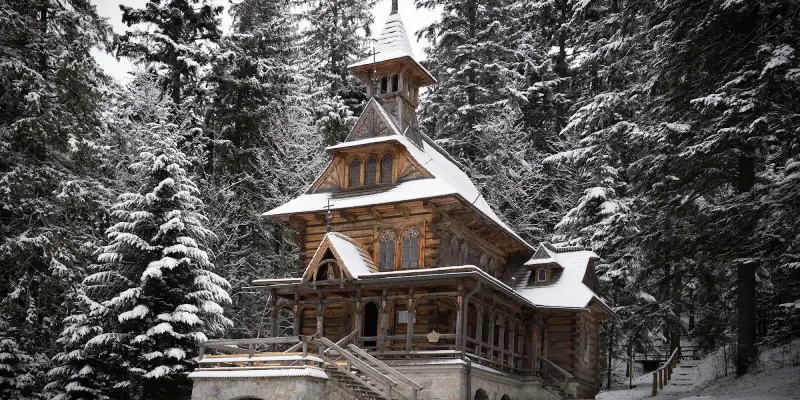
It ends with the Sacred Heart chapel at Jaszczurówka, one of the purest examples of the Zakopane style and also signed by Witkiewicz. Work began in 1904 and it was consecrated in 1907: logs on a high stone base, arcaded porches, a shingle roof and a small belfry. Inside, the wooden high altar is conceived as a highlanders’ hut, and Stefan Witold Matejko’s windows show Our Lady of Częstochowa and Our Lady of Ostra Brama. It has been a protected monument since 1993 and is part of the Wooden Architecture Trail of Lesser Poland.
Good to know before you set off
- The shrines, the chapel and the cemetery are places of worship and burial: behave accordingly.
- The route gives no distances between stops: plan your transfers on a map and check on the spot how to visit each place.
- The Kuźnice granary hosts temporary exhibitions: they change, so do not count on one in particular.