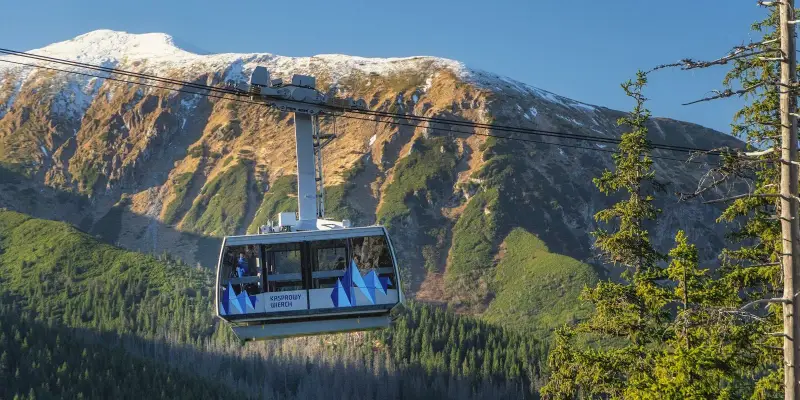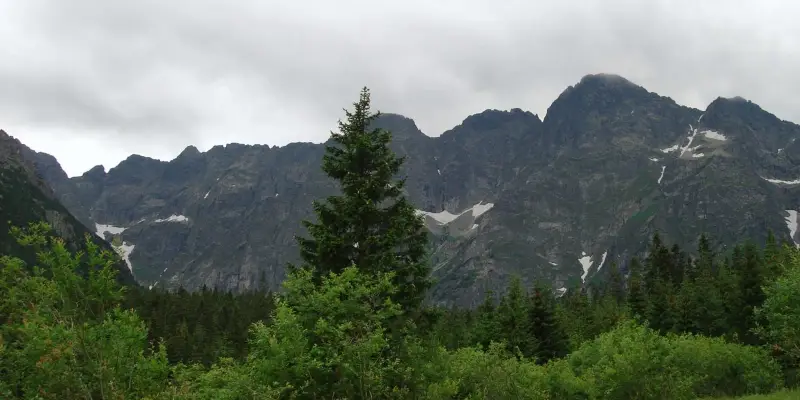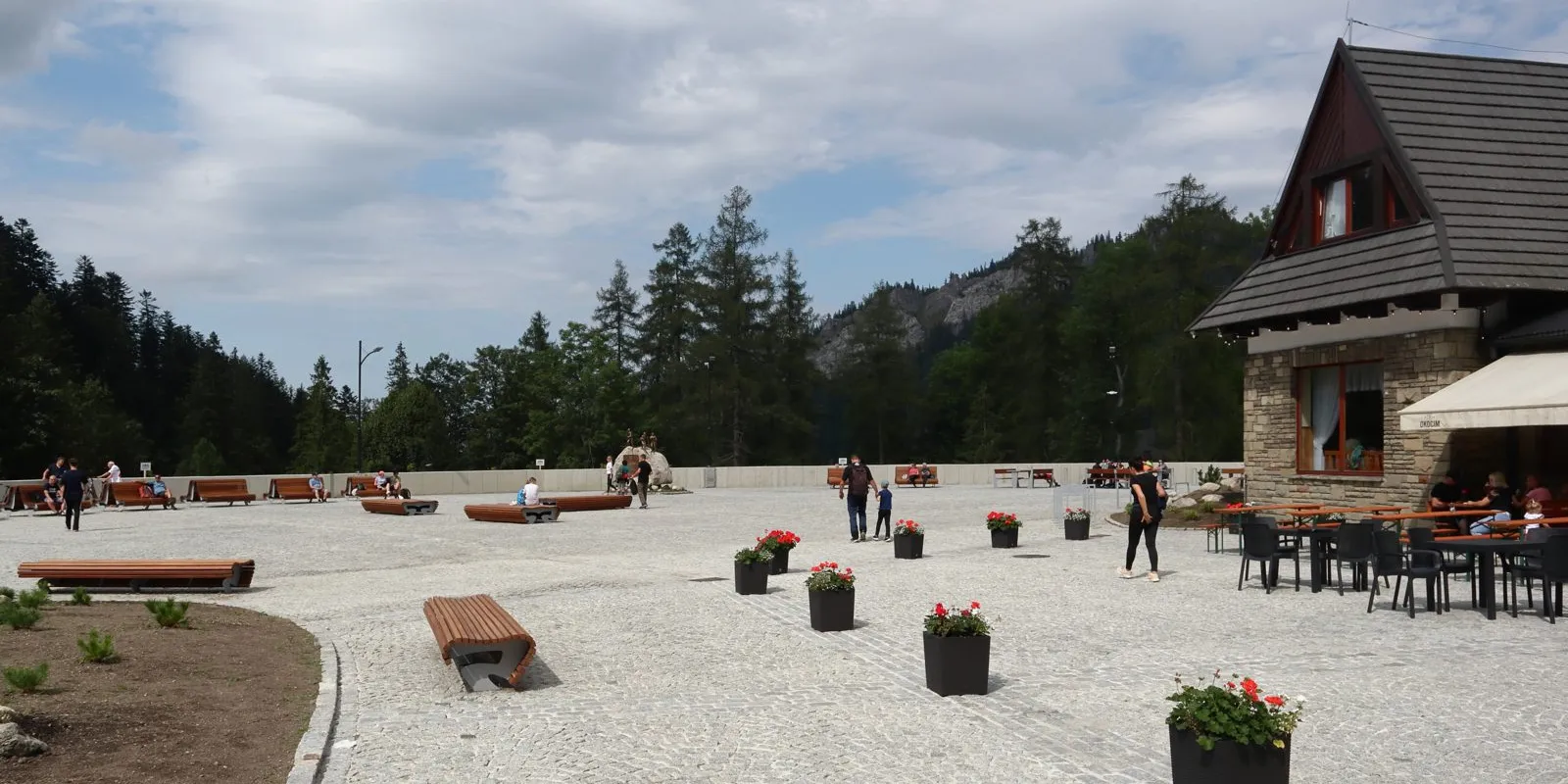
The Kasprowy Wierch cable car was built in 227 days, with materials hauled up on horse-drawn carts and on workers' backs, and today it leaves from a place, Kuźnice, that you can reach without a car. It is proof that Zakopane can be enjoyed without a steering wheel: the town is compact, the trailheads are close, and the real difficulty is not getting there but deciding the order of things. Here is how to get around without a car, with a bit of common sense.
On foot: the centre is made for it
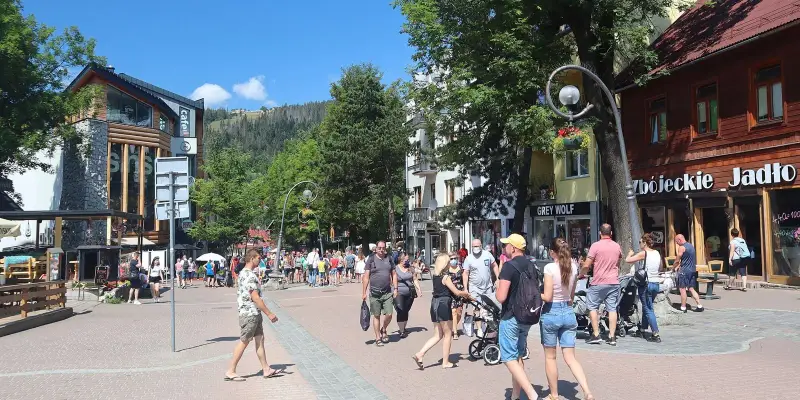
The heart of town, Krupówki, is a pedestrian street closed to cars and bicycles, a little over a kilometre long: you walk from end to end among shops, restaurants, horse-drawn carriages and glimpses of Gubałówka and Giewont. Much of what there is to see in the centre sits a few minutes apart, from the Tatra Museum (at no. 10 on the street) to the wooden villas on the side streets. If you stay nearby, you can do without any vehicle for days. One warning: in winter the pavements ice over, and shoes with good grip make a difference.
For the first days, walking is also the best way to get your bearings. The town is long, and distances between districts can surprise anyone who trusts the map: a trip that looks short on screen can become a proper walk, especially uphill or in snow.
Towards the mountains: Kuźnice and the cable car
The easiest gateway to the Tatras is Kuźnice, where the cable car starts and many trails begin. The cabin line runs from Kuźnice via an intermediate station at Myślenickie Turnie to the upper station at about 1,959 metres, just 26 metres below the summit of Kasprowy Wierch; over 4.25 km it climbs 936 metres. It is the most comfortable way to gain height without effort, but it is not a half-hour affair: queues can be long on fine days, and at the top the weather changes fast, so warm layers are needed.
You can reach Kuźnice on foot from the centre, as a walk, or by public transport. If the walking is already the plan, adding the cable car for the ascent or the descent is a good solution: ride up and walk down, or the reverse, makes a full day without overdoing it. Ask locally about trail conditions and the weather before you decide.
Buses and minibuses: the system that goes everywhere
For the valleys and the farther trailheads you use buses and minibuses. Services leave the town for the trailhead car parks and for nearby villages, and they are the simplest way to reach, for instance, the Kościeliska and Chochołowska valleys without a car. Private minibuses are very common: they usually leave when full, which is handy but unpredictable, and it pays to arrive early on busy days.
The basic rule is to check locally where services depart and how they work, because stops and frequencies change with the seasons and a timetable found at random is not to be trusted. Note the last return service too: it is the main source of stress for people hiking without a car, because a day that stretches can make you miss the last vehicle. Write it down at the start, not at the end.
Morskie Oko without a car
The best-known lake in the Tatras is reached from Palenica Białczańska, where an 8.5 km paved road, closed to private cars, leads to the shore. Without a car the problem is getting to that point: the minibuses and buses leaving Zakopane are the sensible choice, and on reflection that is an advantage, because there is no parking to find. From there you walk (red trail), and circling the lake takes about 50 minutes; in season the national park also runs electric buses that shorten the walk. On fine days the crowds are huge: set off early.
How to organise your days
The secret of a car-free holiday is to group things by area: one day Kuźnice and the cable car, one day the centre and the museums, one day a valley reached by bus, one day to breathe. Do not try to combine two opposite extremes in the same day. Carry a light pack with layers and water, and leave a margin for the return. Those who do discover an unexpected benefit: without the thought of the car, you walk more, look more and go home feeling you really saw the town.
Frequently asked questions
How do I get to Zakopane without a car?
By bus or train, usually from Kraków, and the two stations are close to each other, not far from the centre. Buses are often the quicker option. Check locally or on the carriers' sites how routes work, because they vary with the seasons.
Do I need a taxi to reach the trails?
Usually not, because buses and minibuses cover the most-used starting points. A taxi can help outside service hours, for people with heavy luggage, or for a late return after a long day. Always agree the route before getting in.
Can I get around Zakopane by bicycle?
Yes, but not along Krupówki, which is closed to bikes. Climbs toward the trails are demanding and traffic can be heavy on main streets. For regular cyclists it is a pleasant option, provided you check the rules for park trails locally.
Is the last bus a problem?
It can be, especially out of season when frequencies drop. Ask for the last departure the day before and keep a safety margin. If you miss it, a taxi is the alternative, but it is better not to cut it fine.