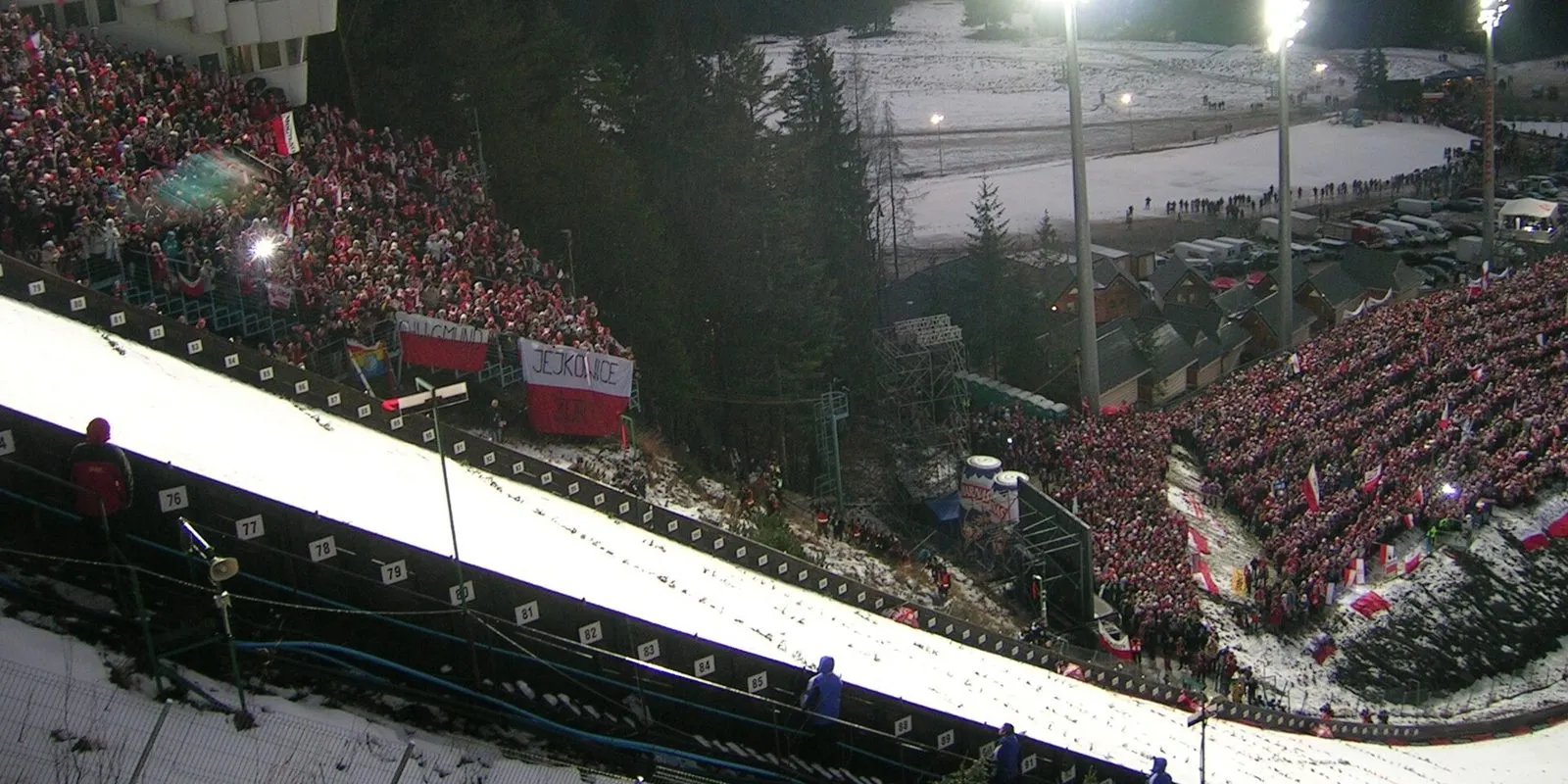
When the January wind swirls over the Wielka Krokiew hill, half of Zakopane stops what it is doing: jumpers drop from the in-run, the stands below the forest fill with red-and-white flags, and the noise of plastic horns drifts all the way down to Krupówki. The event calendar here is not a shop window for visitors but the rhythm of the year for a highland community that has always known how to celebrate.
January: the World Cup in the shadow of Giewont
The Wielka Krokiew hill (HS 140) has been in use since 1925 and has been the temple of Polish ski jumping ever since; the first World Cup jumping here dates from 1980. The FIS Ski Jumping World Cup round usually takes place in January, typically over a weekend, with qualification on the Friday or Saturday and the competition the following day. The crowd is part of the show: on the best days the stand and the meadow below become a sea of fans singing for their favourites. Non-sports fans can still enjoy the atmosphere, but be aware that the town is full, traffic towards the hill slows to a crawl and accommodation should be chosen well ahead. It is also very cold on competition day: insulated boots and layers matter more than a good seat.
New Year's Eve: Zakopane's long night
Zakopane is one of the most popular Polish destinations for Sylwester, as New Year's Eve is called here. In recent years the large open-air concert on Równia Krupowa has been organised by the town, with Polish performers and, in some editions, a regional, folk-leaning line-up, while venues in the centre and hotel ballrooms run their own parties. It is a crowded, noisy evening with many people on the street at midnight, especially on Krupówki: anyone after peace and quiet should pick a guesthouse outside the centre or dine at a countryside inn. The format of the concerts has changed several times over the years, so always check the programme before you go.
Summer: Szymanowski's music
The composer Karol Szymanowski lived in Zakopane during the years in which he discovered highlander music and drew on it for his works. The festival dedicated to him, the Dni Muzyki Karola Szymanowskiego (Karol Szymanowski Music Days), founded in 1977 at the initiative of the museum's curator at Villa Atma, where the museum now stands, takes place in summer, normally in July and sometimes running into early August. The concerts are not limited to the villa: by tradition they use galleries, churches and other cultural venues, and highlander music can also turn up between the classical programmes. For chamber-music lovers it is a rare chance to hear twentieth-century pieces in the landscape that inspired them.
August: the highlanders' festivals
In August, usually in the second half of the month, the Międzynarodowy Festiwal Folkloru Ziem Górskich, the International Highland Folklore Festival, brings mountain groups from many countries to town. It has carried this name since 1968, though its roots go back to the 1935 «Święta Gór» highlander gatherings; it is a competition with an international jury that awards the Golden, Silver and Bronze Ciupaga (the ciupaga is the highlanders' small shepherd's axe). The main days usually include a costume parade through the town centre and open-air concerts: it is a good moment to see the costumes, dances and instruments of mountain peoples up close.
Also in August, in Bukowina Tatrzańska, the Sabałowe Bajania festival is held. It started in 1967 and is still built around contests for storytellers, instrumentalists and singers; it is named after Jan Krzeptowski Sabała, the celebrated tale-teller nicknamed the Homer of the Tatras. It opens with the bands passing through the village on horse-drawn carts and is, among the folklore events of Podhale, one of those most closely tied to oral tradition.
Planning without surprises
Exact dates change every year, and the format of some events can change too: before booking, check the official calendar of the town and of the organisers. On festival and competition days accommodation and restaurants fill up early, so the rule is to plan far ahead. Mountain hikes should never be planned around an event: trail conditions change and Tatra weather is severe, even in summer. In a mountain emergency call 112 or the Polish mountain rescue service TOPR on 985. If you want to see Zakopane without the crowds, the right window lies outside these events, but anyone who wants to understand the town's character should fit at least one of them into the trip.