In 1935 work began on a cable car up one of the windiest summits in Poland, and by 1936 it was running: the Kasprowy Wierch cable car was built in under eight months (227 days from the start of works to the first passengers on the summit), and in the summer of 1936 President Ignacy Mościcki rode up too. Since then Zakopane has gathered more curious records, some worth remembering, others simply good for dinner conversation.
From Kuźnice to an observatory at 1987 metres
The cable car leaves from Kuźnice and reaches the summit of Kasprowy Wierch at 1987 m. Up there, since 1938, stands a meteorological observatory: it is the highest-located building in Poland. You can leave town in sunshine and find yourself in cloud ten minutes later, which is why the weather numbers around here always run a little extreme. Before deciding to go up, check the mountain forecast, not the town one.
The −34.1 °C frost and the wind of the century
According to climate records, the lowest temperature ever recorded in Zakopane is −34.1 °C, on 1 February 1956. On 6 May 1968, in the middle of spring, a violent foehn wind hit the Tatras and the Kasprowy Wierch observatory recorded gusts of 270 to 288 km/h (sources differ on the exact figure), the «wind of the century» for Polish meteorologists. These figures are far from the average visitor's experience, but they are a reminder that mountain weather can turn quickly, even out of season. Yet it was precisely the cold, dry air that made the town: from the 1870s the physician Tytus Chałubiński promoted its climate, and in the mid-1880s (sources give 1885 or 1886) Zakopane received official recognition as a climatic station, the first step towards today's tourism.
A chalet that became a style, a ski jump that became a myth
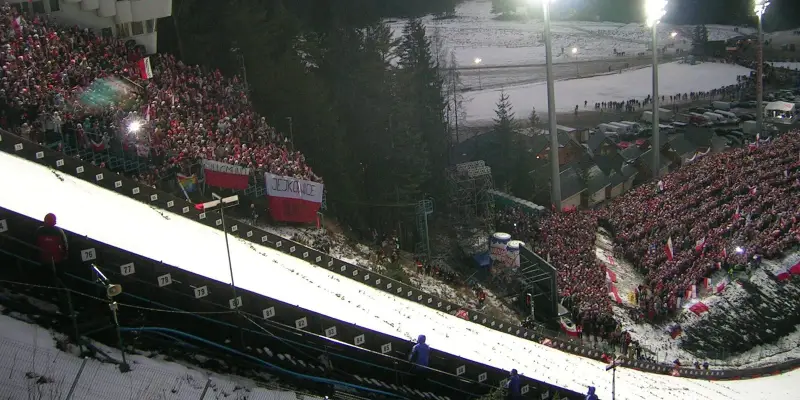
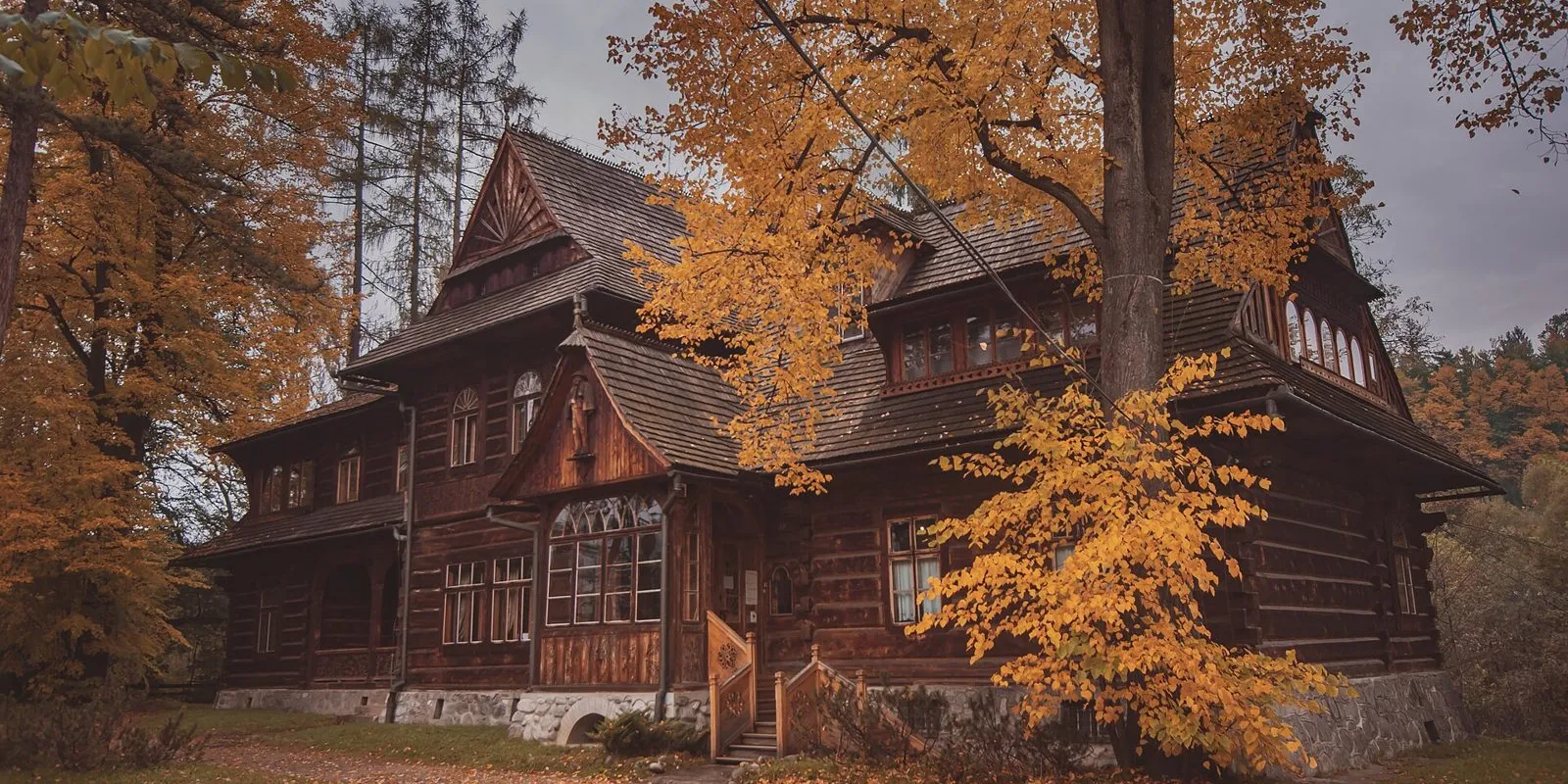
Villa Koliba, built in 1892–93 to a design by Stanisław Witkiewicz, opened the way for the so-called Zakopane Style: exposed beams, steep roofs, decoration inspired by highlander craft. It is now a museum, and worth a visit to see how a single building produced a whole aesthetic. In a similar spirit, Wielka Krokiew, designed by Karol Stryjeński, opened in 1925. Its size today is K-125 and HS 140, the largest ski jump in Poland, and it hosted the ski world championships in 1929, 1939 and 1962. You can visit in summer too: standing underneath, the steepness of the in-run makes your head spin.
Giewont, Morskie Oko and a border at 2301 metres
From the streets of Zakopane, Giewont (about 1895 m) looks like a knight lying on his back: legend says the sleeping knights will wake when Poland is in danger. On the summit, in 1901, a steel cross about 15 m tall was set up, still one of the symbols of the town. In storms the cross and the chained section below it are dangerous: do not stay on the summit in a thunderstorm.
Morskie Oko, at 1395 m, has a maximum depth of about 51 m (measurements range from 50.4 to 51.8 m). For a long time the story went that it was linked to the sea underground, in some versions to the Adriatic, hence the name, which means «eye of the sea». Finally, a map curiosity: the municipal territory of Zakopane reaches the Slovak border and, according to encyclopaedic sources, its highest point is Świnica, at 2301 m. In a mountain emergency call 112 or TOPR (985).