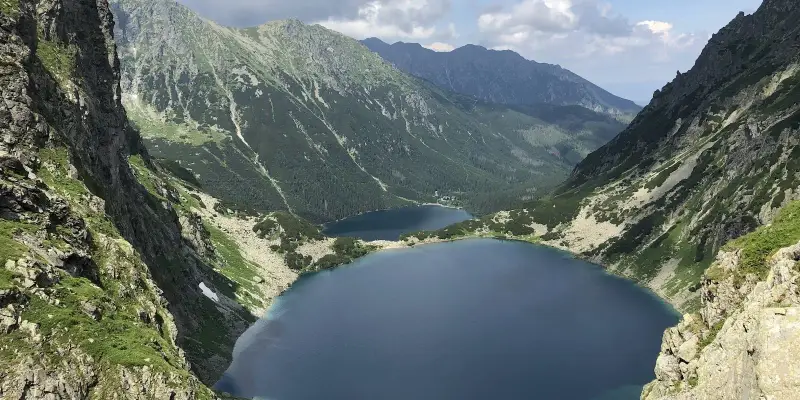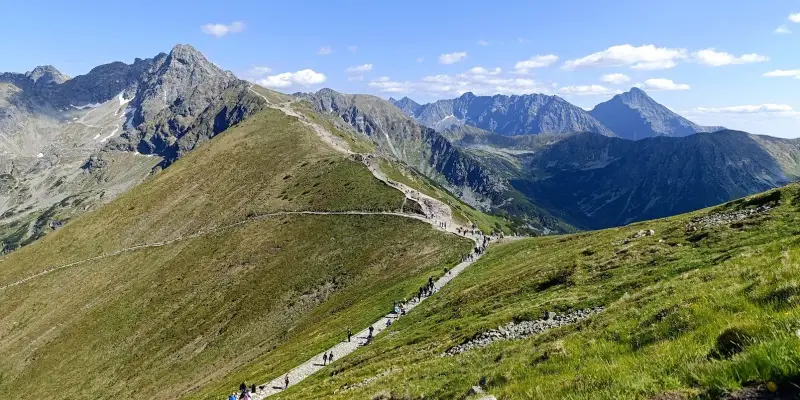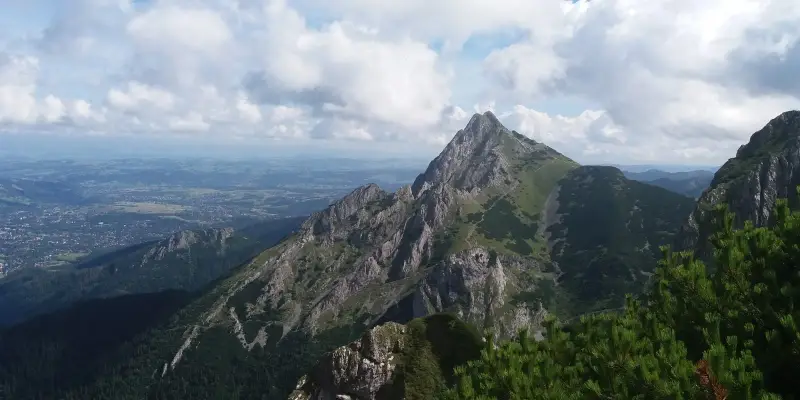
On the summit of Kasprowy Wierch the border between Poland and Slovakia runs a very short distance from the weather observatory: Poland to the north, the Tichá valley (Cicha dolina) and Slovakia to the south. One glance south is enough to see that the Tatras do not end where Zakopane ends. The range is a single wall, yet its two slopes have different characters, and the Slovak Tatras hold the highest peaks, glacial lakes tucked under granite faces, and mountain resorts that look nothing like the Polish town.
One range, two ways of living it
The Polish side has Zakopane, a real town with its streets, workshops and history, from which you set out for the valleys. On the Slovak side the logic is reversed: the mountain resorts form a string of small settlements along the foot of the range, each with its own cable car or trail, and the rock wall seems much closer to the houses. You notice it from the car window: the Slovak Tatras, called Vysoké Tatry, rise almost without foothills, and the feeling is of a wall closing the horizon.
This is also where the highest point of the whole range stands, Gerlach, at more than 2,650 metres. It is not an objective for ordinary walkers; it requires mountaineering experience. Much easier, and a better fit for visitors coming from Poland for a day, is to look at these peaks from below, from a lake or an intermediate station.
Štrbské Pleso: the lake and the glacial amphitheatre
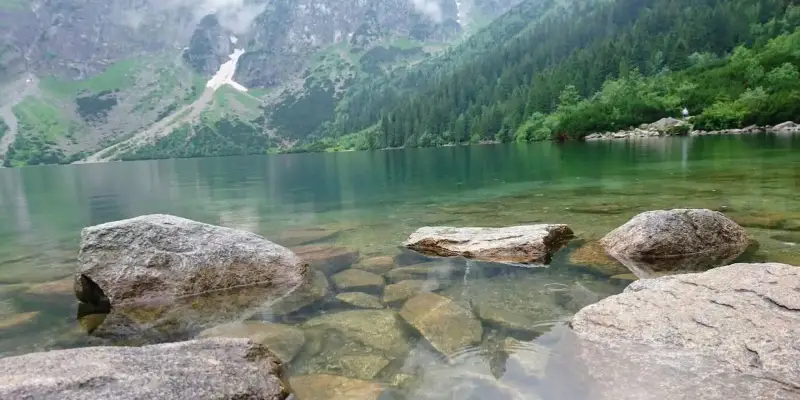
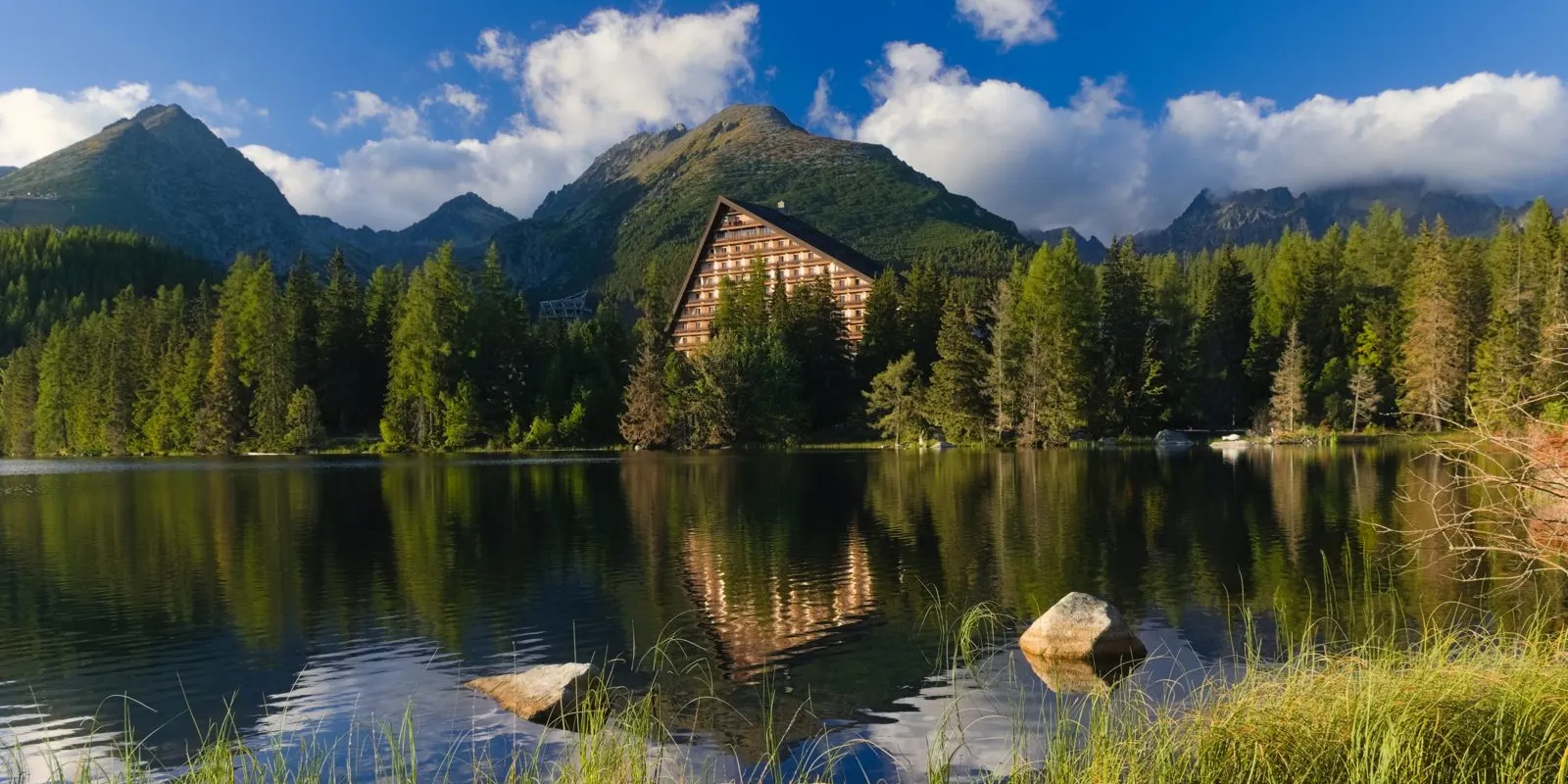
The classic first stop is Štrbské Pleso, a glacial lake that gives its name to the resort growing around it. The view is exactly right: dark water, spruce, and behind them a jagged ridge that changes colour with the light. The Nordic World Ski Championships were held here in 1970, and the sporting past is still visible in the buildings around the shore. If you feel like walking, there are trails climbing to higher tarns, including Popradské pleso, that bring you close to the walls without requiring a real climb.
An honest note: on fine days the resort is busy, and the shore can feel more like a leisure centre than a corner of wilderness. The best part begins a few hundred metres up the path, where the crowd thins out quickly.
Tatranská Lomnica and the summits you reach without climbing
If Štrbské Pleso is the lake, Tatranská Lomnica is the gateway to the highest altitudes. From here the cable car climbs to Skalnaté pleso and then to the summit of Lomnický štít, which at 2,634 metres is one of the best-known peaks of the Tatras and carries an observatory. It is one of the few places in the range where you reach such a height without physical effort, and the panorama is vast when the sky is clear. When cloud sits on the summit, though, the ride loses most of its point: check conditions and decide at the last minute rather than fixing the day far in advance.
Between the two resorts a scenic road runs along the foot of the range, and another stop worth making is Starý Smokovec, the historic centre of the Slovak resorts, with its late nineteenth-century villas and the small funicular that rises towards the high trails.
Getting there without making it a project
Poland and Slovakia are both in the Schengen area, so the border is crossed without systematic checks, but carry an identity document. Slovakia uses the euro, not the złoty: a detail easily forgotten that causes minor trouble. From the Zakopane area you can drive via Łysa Polana or use bus connections; routes and frequencies change over time, so check shortly before leaving. On the way you will also pass Ždiar, a village with traditions close to those of the Polish górale.
Once there, small electric mountain railways link the resorts to one another and to Poprad, the largest town in the area. They are convenient and make a rental car unnecessary for anyone hopping from one place to the next.
A well-built day, and the one to avoid
For a single day the most sensible choice is one resort only: Štrbské Pleso if you want a lake and an easy walk, Tatranská Lomnica if you are interested in going high by cable car. Trying to see everything in a day means spending more time in transit than on the trails. With two days you can do both without hurry, perhaps sleeping on one side.
On safety the same rules apply as on the Polish side, with one difference worth knowing: on Slovak trails leaving the marked path is forbidden, and in some high areas there are seasonal closures of trails. Conditions change, so ask locally before setting out. The single emergency number valid everywhere in the European Union is 112.
And if the weather in Zakopane is bad? The weather can differ from one slope of the range to the other, and checking the forecasts for both sides can turn a grey day into a successful trip.
Frequently asked questions
Can you walk from Poland into Slovakia in the Tatras?
Yes, the main ridge is the border and some marked trails cross it, for example at Kasprowy Wierch or on the route towards Rysy. The route depends on weather and seasonal closures, so ask locally before climbing and stay on marked paths.
What is TANAP and how does it relate to the Polish park?
TANAP is the Slovak Tatra National Park, bordering the Polish one. Since 1992 the two parks together form a UNESCO biosphere reserve, so wildlife and plants are the same on both slopes, with Tatra marmots and chamois living on each side.
Is there anything worth adding beyond the Slovak Tatras?
Yes, the Spiš region has Spišský hrad, a castle on the UNESCO list, with the town of Levoča close by. They suit a second day, when mountain weather is poor and you would rather follow a historical itinerary.
Do people speak Polish in Slovakia?
Not officially: the language is Slovak, which resembles Polish enough to decipher signs and pick up some phrases. In the Tatra resorts English and often German are understood, so communicating is rarely a problem.