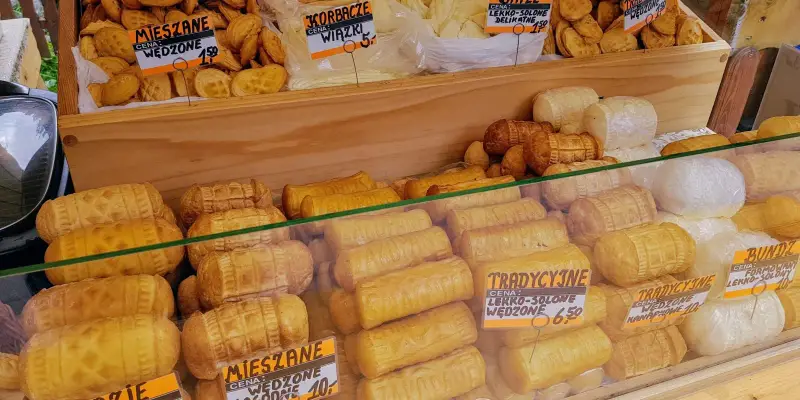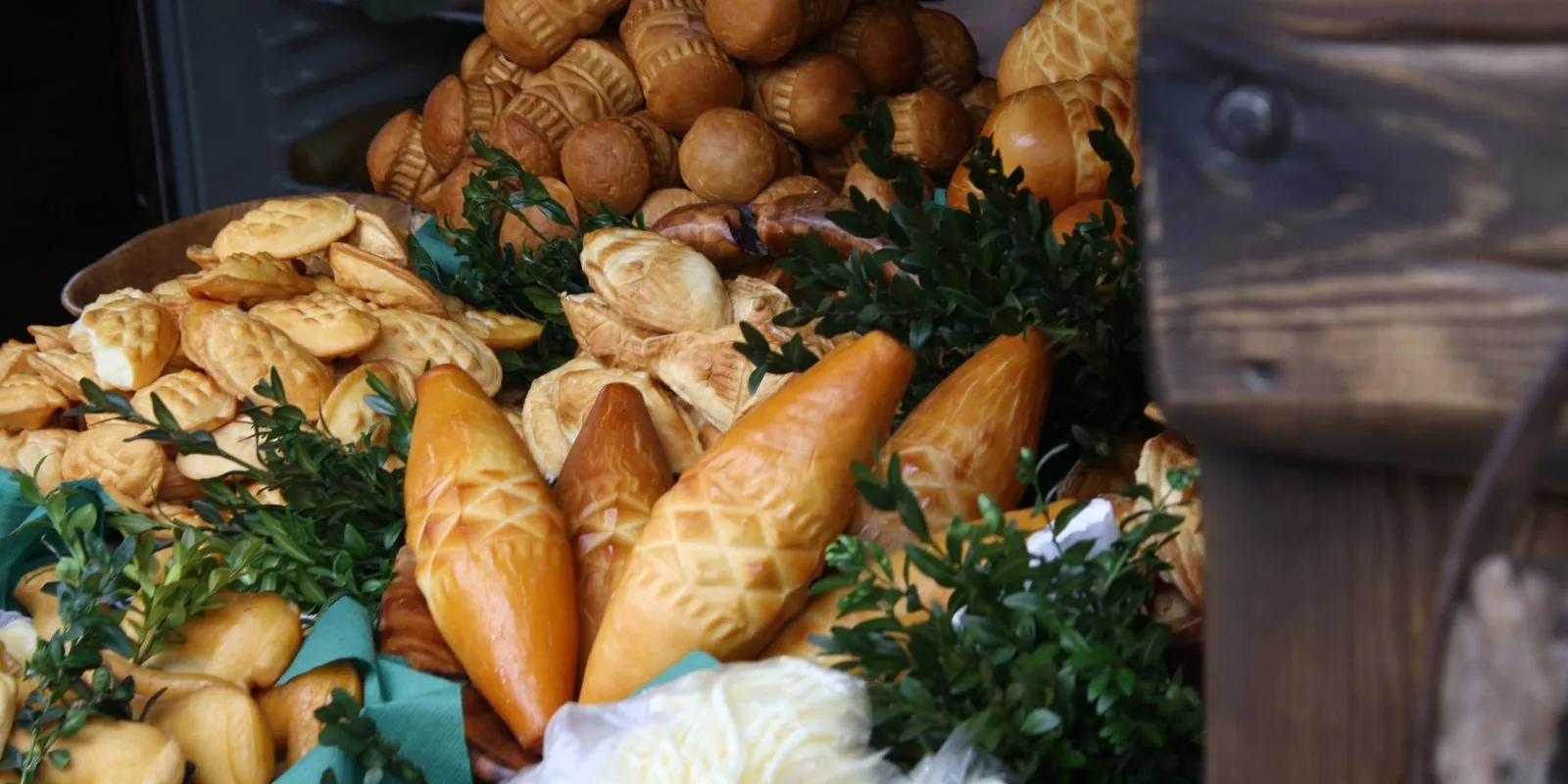
It is shaped like a small spindle, with a dark amber crust and a pattern pressed into the surface that looks borrowed from woodcarving. Oscypek is easy to recognise before you taste it. It is the smoked sheep's-milk cheese of the górale, the highlanders of the Podhale region, and in Zakopane you find it everywhere: on kiosk grills, on market tables, in the shop windows of Krupówki. It is worth knowing what is in front of you, because the gap between a carefully made oscypek and one made for passers-by shows up at the first bite.
What oscypek actually is
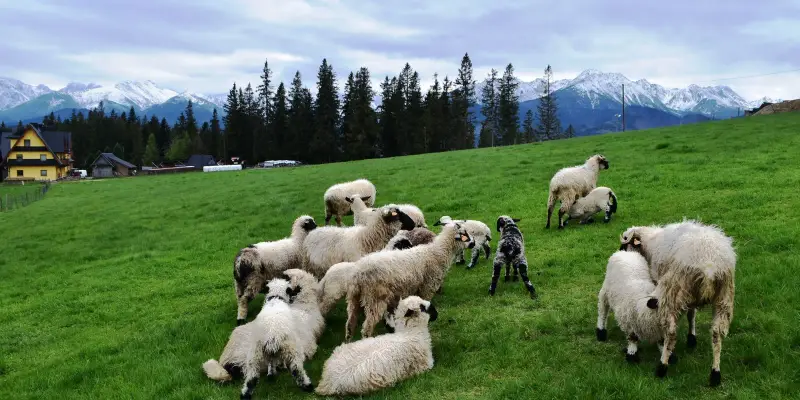
It is a firm cheese made from sheep's milk (the specification allows up to 40% cow's milk), brined and then smoked. The recipe comes from the Podhale mountain pastures, where shepherds took their flocks up for the summer and turned the milk into cheese on the spot, in wooden huts. The name is protected at European level, which means a product sold as oscypek must follow a defined specification and come from a defined production area covering Podhale and neighbouring Beskid districts. If you expect something like a smoked mozzarella, adjust your picture: the texture is denser and slightly springy, almost squeaky under the teeth, and the flavour is salty, faintly tangy and full of woodsmoke.
The work is done by hand. The curd is kneaded and pressed into carved wooden moulds, which leave the decorative motifs on the crust, then the cheese goes into brine and finally hangs in the smoke of the hearth, where it dries and takes its colour. The result is a spindle-shaped piece roughly twenty centimetres long that keeps far longer than a fresh cheese.
How to eat it: grilled, with jam
The most common way, and the most surprising for visitors, is warmed on a grill until the crust turns golden and the inside softens. It is served with a spoonful of cranberry jam (żurawina in Polish), whose sharp sweetness cuts through the salt and smoke. A sweet-and-salty pairing can sound odd; after the first bite it stops sounding odd. A hot oscypek makes a good snack after a walk, or a starter to split between two people.
You can also eat it cold, in slices, with bread and a cup of tea or a local beer. The smoke is strong in either form, so if you do not like bold flavours, start with a small piece.
How to spot the real thing
Not everything sold under this name is made with care, and honesty helps here. A few practical clues. First, shape and pattern: a traditional oscypek has the spindle profile and motifs from a carved mould, not the smooth surface of an industrial block. Second, colour: natural smoking gives a tone from pale straw to amber, while a uniform, very dark brown can mean the colour was added in a hurry. Third, look for the European protection label (PDO), which points to a registered producer.
The best advice is simply to ask. Makers are usually glad to explain where the milk comes from and how the cheese is smoked, and a stall that cannot answer is telling you something. Even better, if you walk in the valleys, taste it where it is made.
Where to try it in Zakopane
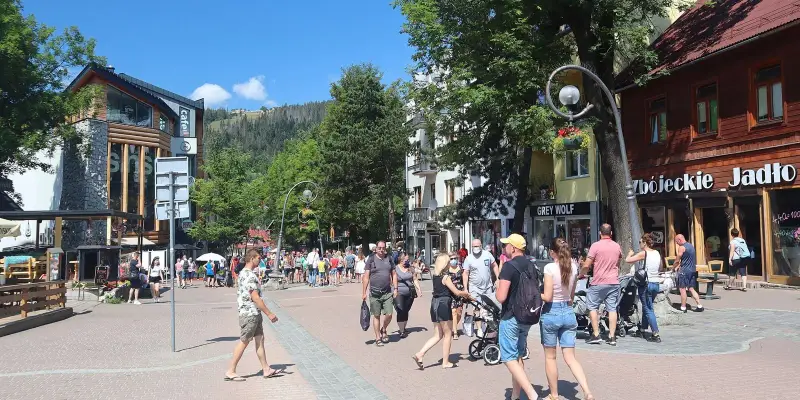
The most down-to-earth spot in town is Targ pod Gubałówką, the market on Na Gubałówkę street, a short walk from the lower funicular station. Oscypki are sold there next to souvenirs and regional crafts, in a setting that feels more everyday and less polished than Krupówki. Along the pedestrian street you will mostly find kiosks selling the grilled version ready to eat: handy and photogenic, but more tourist-oriented.
You can do both in one afternoon: a hot oscypek eaten while strolling under the funicular, and another to take home, chosen calmly at the market. If you have time, on a mountain clearing such as Polana Rusinowa the shepherds' hut with grazing sheep sells oscypek and other sheep cheeses in the warm season, and that is where the whole story starts to make sense.
Taking it home, and who should skip it
Oscypek makes a practical souvenir because it travels well and lasts a good while. Keep it somewhere cool, wrapped in paper or a breathable cloth rather than sealed plastic, which traps moisture on the crust. If you are flying or crossing borders, check the rules on dairy products for your destination country.
It is not for everyone. If you avoid smoked cheese, salt or sheep's milk, leave it alone, and if you prefer gentle flavours, other sheep products of the area, such as fresh bundz or bryndza, suit you better. For everyone else, a hot oscypek with sharp jam is one of the flavours that best explains the Podhale: a cheese made to feed people who spent the summer high up with their sheep, and which today, in the smoke of a grill and the smell of woodfire, says more than a postcard.
Frequently asked questions
Is oscypek eaten raw or cooked?
Either way works. Cold and sliced it tastes salty and smoky; warmed on a grill it turns softer. In Zakopane the hot version with cranberry jam is by far the most common way to eat it.
Is oscypek made only from sheep's milk?
Mostly, but not only: the European specification requires sheep's milk and allows up to 40% cow's milk. The intense, slightly tangy taste comes from the sheep's milk and the smoke. To tell the real thing apart, look for the European protection label or ask the maker.
How long does oscypek last after buying it?
Kept in a cool, dry place it lasts reasonably long, though less than an industrial aged cheese. Follow the date on the label, and avoid storing it in sealed plastic, which makes the crust damp.
Can I take oscypek on a plane?
Usually yes, in checked luggage and well wrapped, but rules for dairy products depend on the arrival country. Within the European Union it is normally fine; for other destinations check customs rules before you travel.