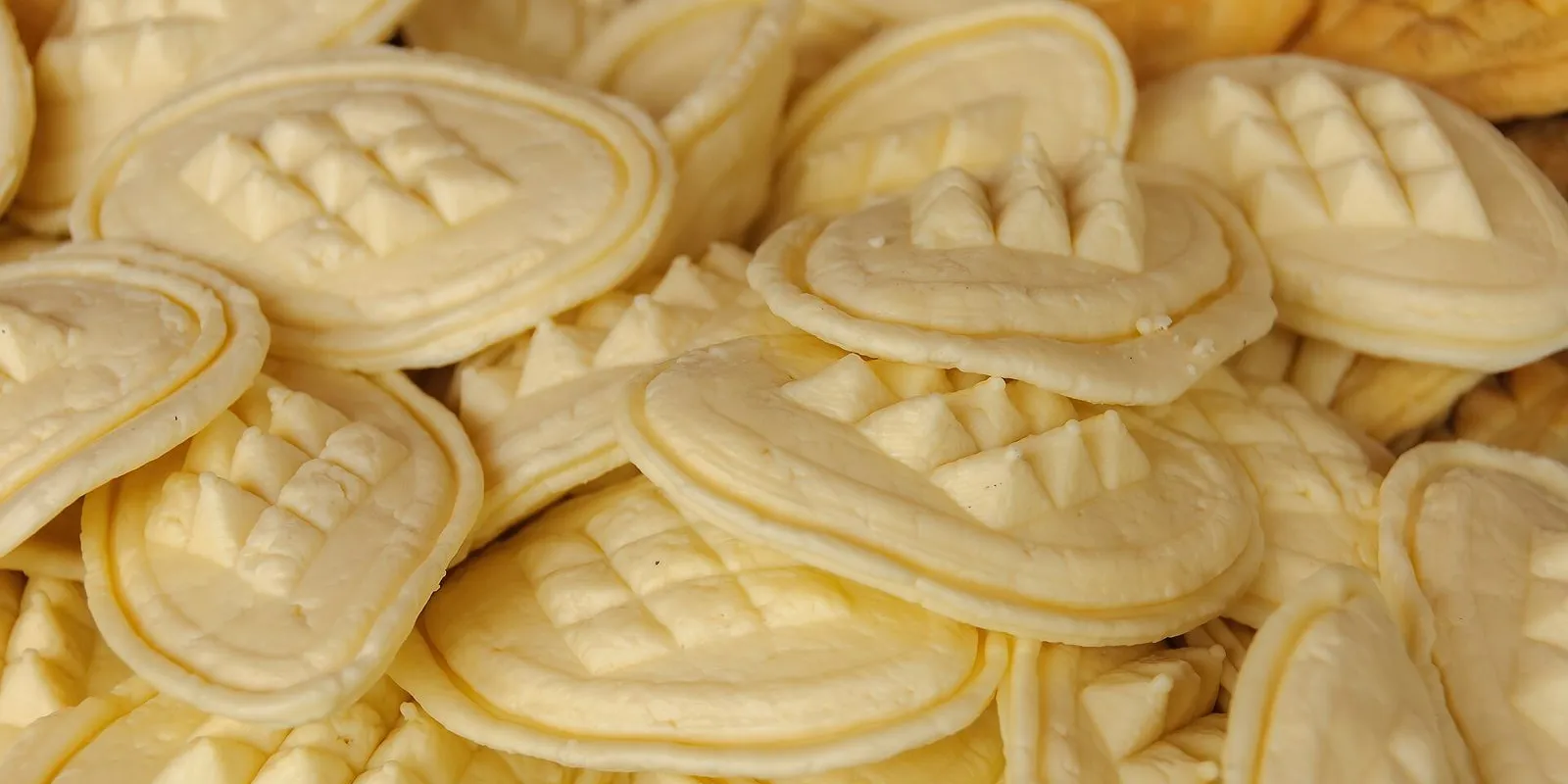
The emblem of the górale table is a cheese shaped like a spindle that smells of a fireplace. Oscypek weighs 600 to 800 grams, is pressed into carved wooden moulds that print their patterns on the rind, and is then smoked over conifer wood in the shepherd's hut. Since 2008 it has carried EU PDO status: the specification calls for at least 60% sheep's milk from a local mountain breed, with no more than 40% cow's milk, and production follows the grazing season, from May to September.
How to spot a real oscypek
An authentic oscypek has a light brown, slightly glossy rind and a firm, salty, smoky taste; the paste is neither soft nor rubbery. Look for the PDO mark on the packaging or in the seller's paperwork. At the stalls on Krupówki and near the ski lifts not everything on sale carries the certification, and next to oscypek you will find redykołka, a smaller cheese of the same family, often shaped like a little heart or animal, also PDO and very good in its own right but not the same thing: check the label. If you want the real article, with a compact paste and the smoke up front, it is worth walking up to a shepherd's hut in summer, for instance on Polana Rusinowa, one of the few glades in the Tatra National Park where traditional grazing, the "wypas kulturowy", is still practised.
In restaurants oscypek almost always arrives grilled with cranberry sauce. The sweet-and-salty pairing surprises palates not used to it, but it is the most common way to try the cheese.
The main event: soups and flatbreads
Next to it stands bryndza podhalańska, a soft, white, salty sheep's cheese, also PDO since 2007, that goes with almost everything. Mountain cooking is designed to warm you up. Kwaśnica is a deliberately sour sauerkraut soup, savoury and well seasoned, usually made with smoked pork ribs and, in the more pastoral version, with mutton. In the traditional version the potatoes are boiled separately and eaten on the side, or the soup is served with bread; as a rule there are no carrots or other vegetables.
Moskole are flatbreads of boiled potatoes, flour and salt (some recipes add an egg or buttermilk), originally baked on the big plate of a wood-fired stove and today often in a frying pan: slightly crisp outside, soft inside. They are eaten with garlic butter, with bryndza or with smoked bacon. Placek po zbójnicku, "the highwayman's placek", also called "the Hungarian way", is a large potato pancake covered in goulash, almost a meal in itself, found in nearly every inn in the region. Portions are generous, and two people can share one comfortably.
To drink: sheep's whey and tea with electricity
Żętyca is a traditional drink made from the whey left over from making oscypek and bundz. Fresh, it is slightly sweet and turns more sour after a few days. You taste it mainly in shepherds' huts during the grazing season, and it is more a curiosity than an everyday habit. Herbata z prądem, tea "with electricity", also known as "herbata po góralsku", is the classic after a day in the snow: strong black tea with vodka, rum or another spirit in it. It is stronger than it sounds, so skip the downhill run after the second glass.
Practical advice for ordering
If you only have one meal, order a kwaśnica and share a placek: you get acidity, smoke and potato in one go. Vegetarians will find moskole with bryndza or grilled oscypek easier than a meat-free soup. The flavours are strong and salty: this is cold-weather food, and in high summer it can feel heavy. For dessert, cafés in the centre sell kremówka, the cream-filled puff pastry found all over Poland and therefore not tied to Zakopane.