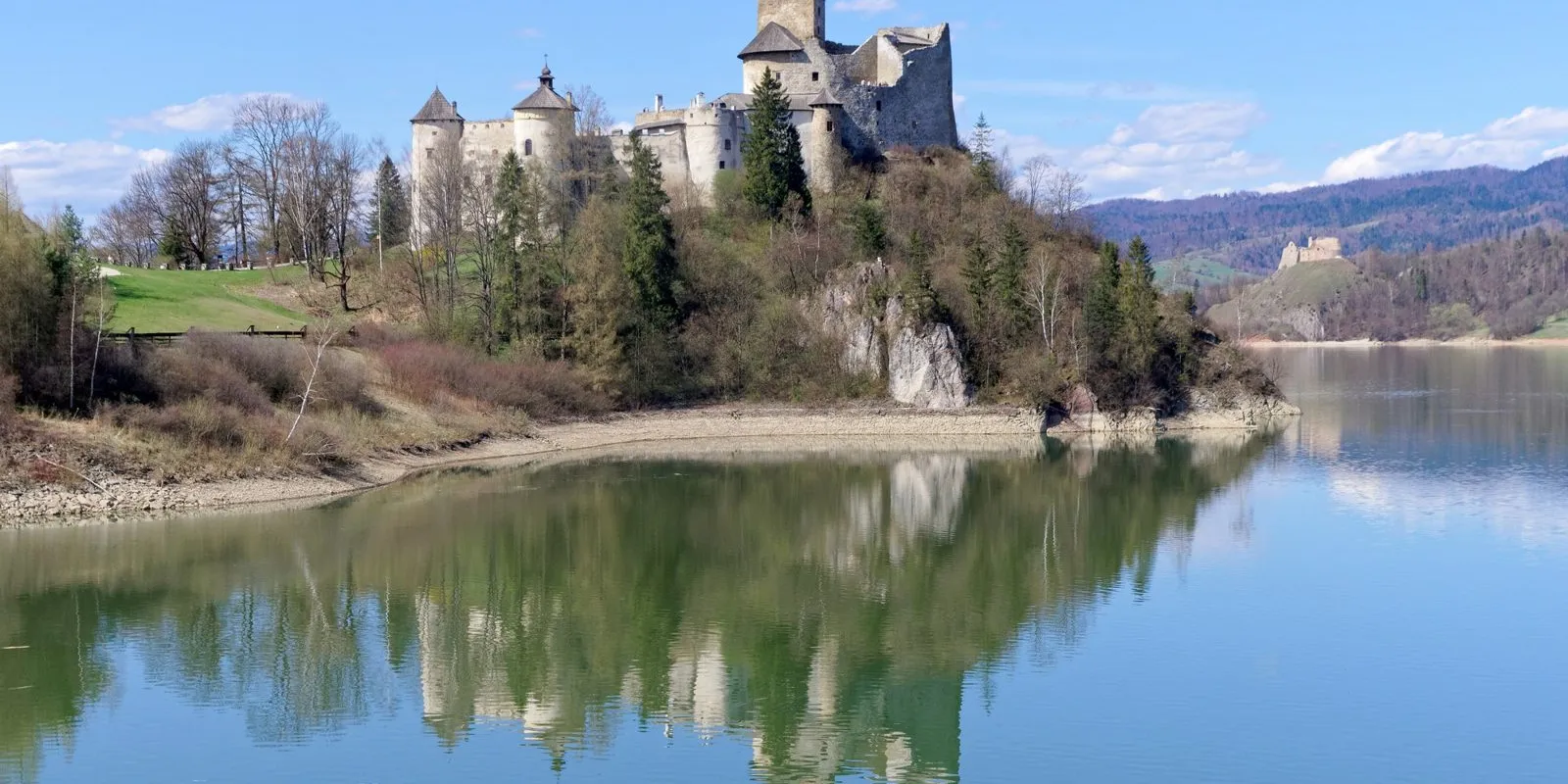
For centuries the Dunajec here was not a river but a border: the Kingdom of Poland on one bank, the Kingdom of Hungary on the other, and two castles facing each other a short distance apart, each serving a different king. Today most of that river is a lake, Lake Czorsztyn, and the two castles are reflected in its water: Niedzica on the south shore, compact on its hill, and Czorsztyn opposite, reduced to ruins. It is one of the most photogenic day trips you can make from Zakopane.
Niedzica, the Hungarian fortress
Niedzica Castle, also called Dunajec Castle, was built at the start of the 14th century, in all likelihood by a Hungarian nobleman of the Berzeviczy family. For centuries it belonged to the Kingdom of Hungary and watched the frontier with Poland. It changed hands often: owners included the Berzeviczy family, then the Zápolyas, the Łaskis, the Horváths and finally the Salamons, who left the castle in 1943 and never returned. After the war the building was restored and in 1963 a museum opened in it.
You walk through its rooms, courtyards and towers, and the whole is more harmonious than you might expect of a border fortress. Inside are archaeological finds, ethnographic objects from the Spiš region, antique clocks and 19th-century firearms. Climbing the tower is worth it: the view takes in the lake, the Pieniny and, on clear days, the dark line of the Tatras.
Like many castles, Niedzica has its stories. According to legend, a descendant of the Incas came to the castle carrying the secret of a treasure, recorded on a knotted cord known as a quipu. It makes a wonderful tale and no more than that: the quipu, so the story goes, was lost, and the treasure has never been found. Read it as folklore and it is perfectly good.
Czorsztyn across the water
Opposite, on the Polish side, stands Czorsztyn Castle. Its origins go back to the turn of the 13th and 14th centuries and it was greatly extended under Casimir the Great. It later housed a royal governor, was rebuilt in the 17th century under Jan Baranowski, and in 1651 was seized by the highlanders of the Kostka Napierski rising. In 1790 lightning set the roofs on fire and the castle fell into disrepair: today it is a ruin, with the Baranowski Tower still recognisable. If you like atmosphere less tidy than Niedzica's, you will prefer it, and from here you get the best view of its rival's outline.
Do not assume a bridge links the two castles: to get from one shore to the other on foot or by car you drive round the lake, so decide in advance which side to start from, or ask locally about crossing the water by boat.
A lake that was not always there
The lake is artificial. The Niedzica dam, more than fifty metres high and about 400 long, was put into service in the 1990s to protect the Dunajec valley from floods, and it also houses a hydroelectric plant. The reservoir is about nine kilometres long. To create it, inhabited land was sacrificed: the village of Stare Maniowy went under water and its inhabitants were moved to a new village on the shore. The view looks perfect, but it is also the result of a decision that cost some people their homes.
Further downstream, below the dam, a small secondary reservoir, Lake Sromowce, regulates the water level. From there the Dunajec resumes its course between the rocks of the Pieniny. That is the rafting route, and the trip combines well with a raft descent of the Dunajec.
From Zakopane: planning the day
From Zakopane the lake is over an hour by car, via Nowy Targ and Podhale. It is a full-day trip, especially if you want to see both castles. Public transport is possible but less convenient, so check connections in advance, because a missed connection leaves you stranded where services are not frequent.
The advice is to start early, begin with Niedzica, which takes longer, and keep the afternoon for Czorsztyn and the shore. If you plan to add rafting, choose two stops rather than four: doing everything in one day means more hours on the road than at the sights. Museum opening hours and closing days change through the year, so check before you travel.
Who it suits and who it doesn't
The trip suits people who like history, photography and water landscapes, families with children who love castles, and days when the summits are under cloud and the Tatras are hidden. It is less suited to anyone after high-altitude walking or perfect quiet: in the warm season the car parks and terraces fill up. Yet the late-afternoon light on the lake, when Niedzica's walls glow, makes you forget the crowd and explains why this old border stays in the memory of those who pass through.
Frequently asked questions
Which castle should I see if I'm short of time?
Niedzica, because it is the preserved castle you can enter, with a museum and a viewing tower. Czorsztyn is an open-air ruin, best for its view over the lake and the other castle. With one stop, choose Niedzica; with half a day more, add Czorsztyn.
Can you swim in Lake Czorsztyn?
The lake was built as a flood-control reservoir and tourism is secondary. Rules and possibilities for swimming or using boats vary from shore to shore and season to season, so ask locally before you change into swimwear.
Is Niedzica in Poland or Slovakia?
In Poland, but very close to the Slovak border. That is why the castle was for centuries a frontier fortress, Hungarian facing Poland. To cross into Slovakia a valid ID document is enough.
Can I visit both castles in one day from Zakopane?
Yes, with an early start and a car, because the two shores are close as the crow flies but driving round the lake takes time. Adding rafting on the Dunajec as well makes the day very long and tiring.