Anyone who turns up in Zakopane with a bike on the roof soon meets a rule that comes as a surprise: in the Tatra National Park you may ride only where a map and a sign say you may, and that is a short list. It is not an oversight. The trails are narrow, stony and busy with walkers, and a bike coming down fast between two groups on foot is a collision waiting to happen. So mountain biking in the Tatras is real, but it has a very precise geography.
The basic rule: banned, unless signed otherwise
Inside the park, bicycles are allowed only on routes officially opened to them, roads and trails shown on the park's map. On those routes pedestrians always have priority, no argument. The park's trails are closed at night, from dusk to dawn, all year round, cyclists included; exact hours can change, so check the park's website before you set out. No riding home in the dark on a headlamp. Scooters, electric scooters and unicycles are not allowed on the trails.
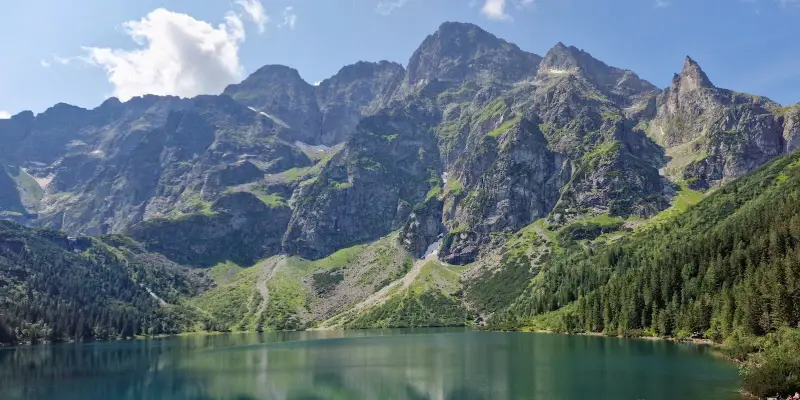
Two bans hit people who dream of the famous destinations. The road to Morskie Oko (Eye of the Sea) is closed to bikes, and so is the Kościeliska Valley, because of the risk of collisions with walkers. Most other trails are out of reach anyway for terrain reasons: rock steps, high ledges, slopes that do not forgive. The rules come from an order of the park director and can change, so check the current map on the park's official website before you set off.
The permitted routes, one by one
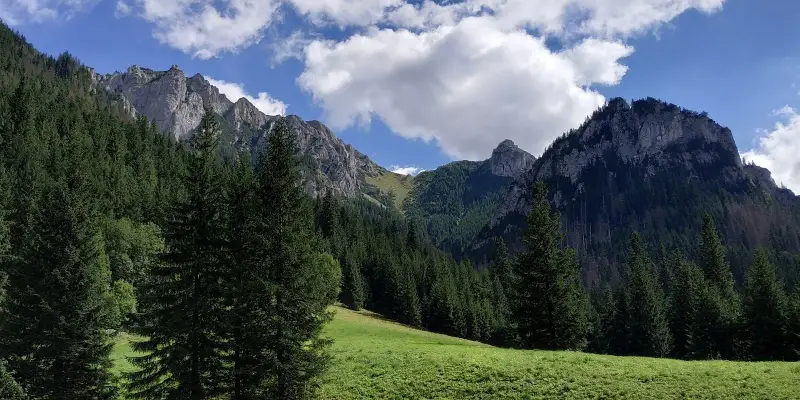
The park lists six routes. The best loved is the Droga pod Reglami: it starts at the Wielka Krokiew ski jump in Zakopane and runs about 10.7 km along the foot of the limestone ridges to Siwa Polana, at the mouth of the Chochołowska Valley. The surface is a wide gravel track with one short stretch of tarmac; it has a few steep bits that are fine to walk. A mountain bike is still recommended over a city bike. In winter one section is closed because it crosses a ski slope, and you detour along a public road.
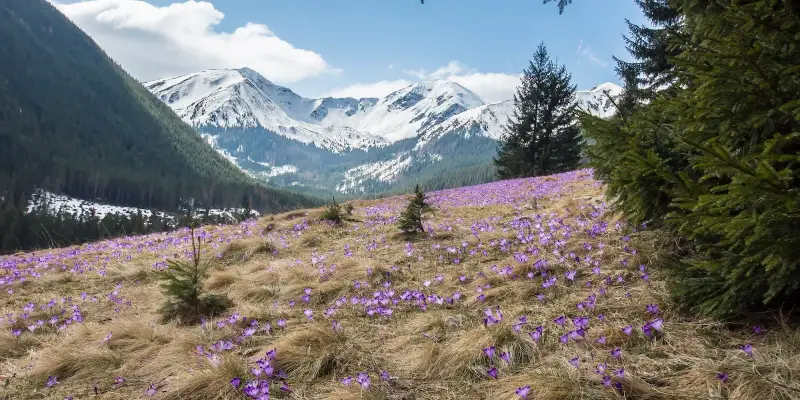
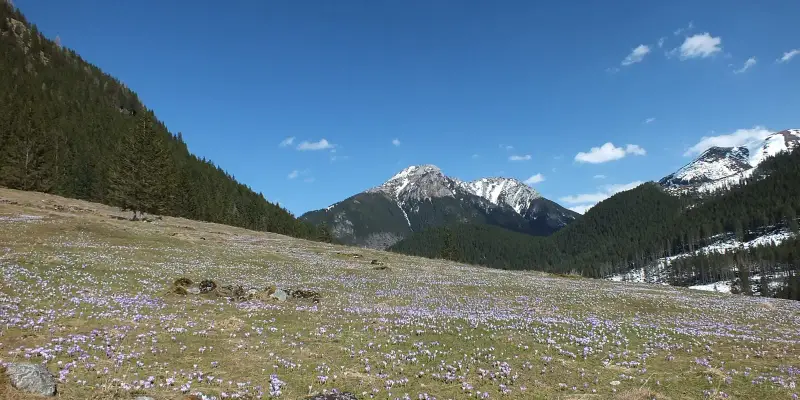
The natural continuation is the Chochołowska Valley, the longest valley in the Polish Tatras. From Siwa Polana to the hut on Polana Chochołowska is about 6.5 km, tarmac as far as Polana Huciska and stony after that. You can stop at the Huciska clearing and turn back. Riding into the valley requires a separate payment, collected by the eight-village community based in Witów: ask at the entrance. In spring the meadow fills with crocuses, one of the best reasons to come here.
The other routes are harder. From Brzeziny, up the Sucha Woda Valley, it is about 6.4 km to the Murowaniec hut on Hala Gąsienicowa, the highest point in the park you can reach by bike: a stony surface and a climb that calls for a proper mountain bike and decent technique. From Kuźnice to Polana Kalatówki is only 1.4 km, but steep and difficult. Around Małe Ciche, east of Zakopane, two more routes start, one towards Zazadnia, Zgorzelisko and Tarasówka and one towards Murzasichle; the descent from Tarasówka is very steep and rough, for very experienced riders only.
Sharing the way with walkers (and with the mountain)
On a road as wide as the one in Chochołowska, in high season, cyclists are a minority among families, pushchairs and tour groups. Slow down, ring your bell, pass gently, and stop for a child. A rider who comes down too fast spoils the day for everyone and hands the park a reason to narrow the concessions further. The night ban stays in force all year round, so you cannot make up time in the dark.
The mountain stays the mountain. Weather in the Tatras changes within hours, wet ground turns slippery, and snow can linger at altitude well into the season. Bring a helmet, a puncture kit, water and a waterproof jacket, and leave a margin of daylight. In an accident the number that works anywhere in the EU is 112; the Polish mountain rescue, TOPR, answers on 985.
What to do outside the park
If the permitted routes are not enough, Podhale offers far more room beyond the park boundary: side roads between villages, farm tracks and meadows with Tatra views. Ordinary road rules apply there and, in woodland, the instructions of the landowners and state forests; prohibition signs count just the same. A simple plan is to alternate: a morning on the Droga pod Reglami, an afternoon among the villages. Bikes can be hired in Zakopane, but e-bikes are handy on long gradual climbs, but the rules on assisted bikes in the park should be checked with the park itself before you rely on a battery.
And across the border?
Anyone looking over the ridge should know that the Slovak Tatras have their own rules, set by the Slovak park authority, TANAP; what holds in Poland cannot be assumed there. The logic is similar, though: few routes open, many bans, and penalties for leaving the track.
In short, mountain biking around Zakopane is a trip to plan on paper rather than free exploration: a few wide roads in the park, plenty of tracks outside it, and courtesy to walkers as the baseline rule.
Frequently asked questions
Can I cycle to Morskie Oko?
No, the road to Morskie Oko is not open to bicycles because of the heavy foot traffic and the risk of collisions. You reach the lake on foot from the Palenica Białczańska car park.
Can I ride after sunset?
No. The park's trails are closed at night, from dusk to dawn, all year round, cyclists included; exact hours can change, so check the park's website. Plan to be back in full daylight rather than counting on lights.
Can I take my bike on public transport to reach the start?
That depends on the carrier and conditions change. The simplest options are to ride from Zakopane to the start of the Droga pod Reglami, or drive to the Siwa Polana car park. For buses and trains, ask the operator before you travel.
Do I need a mountain bike or will a city bike do?
A mountain bike is recommended for the Droga pod Reglami and the Chochołowska Valley, since the surface is stony with some steep sections. On harder routes such as the climb to Murowaniec, a sturdy mountain bike and some technique are essential.