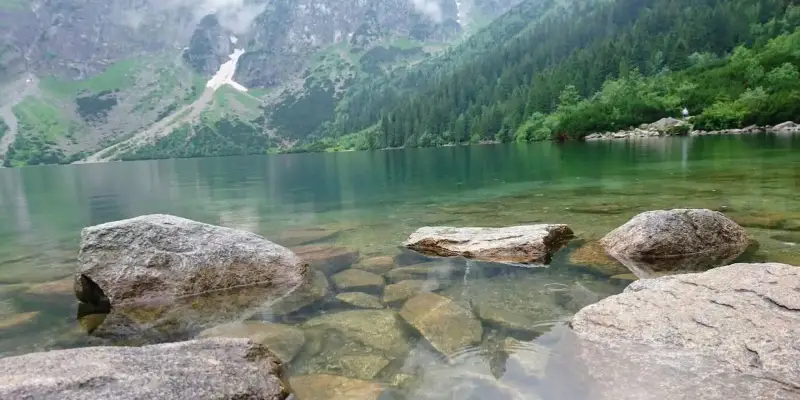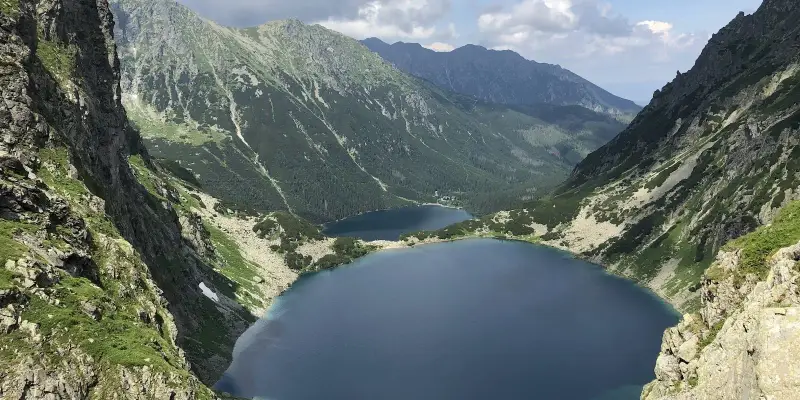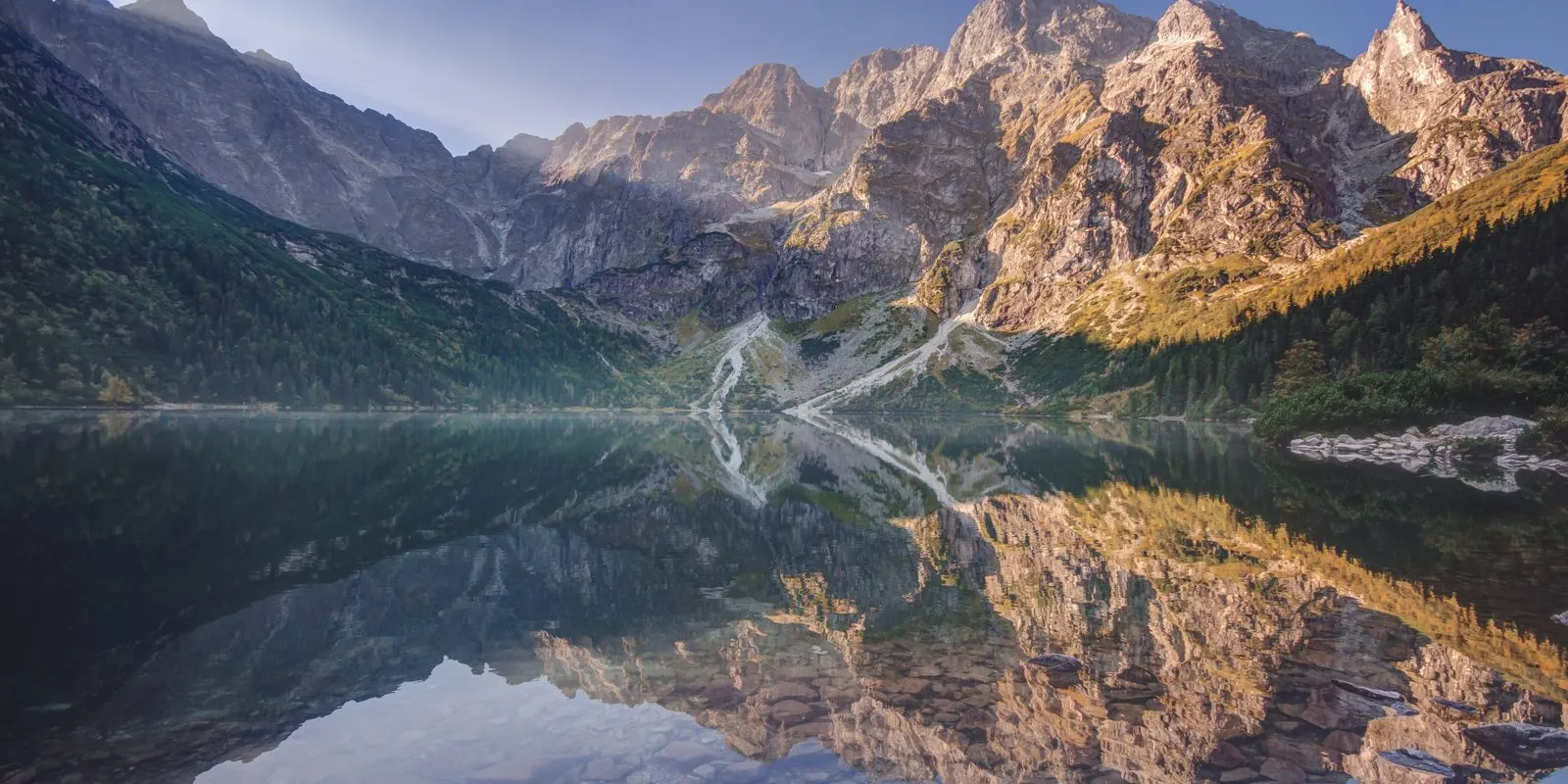
The most romantic name in the Tatra Mountains began as a translation slip. The lake everyone now calls Morskie Oko, the Eye of the Sea, shows up in old sources as Biały Staw as early as 1650, and later as Rybie Jezioro, the fish lake, because it is one of the few Tatra lakes with native trout. The poetic “eye” came afterwards, from a translation out of German. No name has ever done justice to the moment when the road ends and the forest opens: dark water, framed by grey rock walls that seem to drop straight into it.
The asphalt road you walk on foot
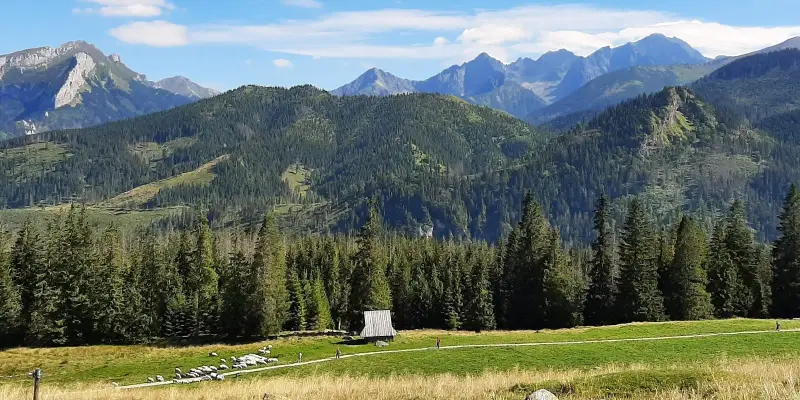
The walk starts at Palenica Białczańska, where you leave the car. From there the lake is 8.5 km away along a paved road closed to private traffic, following the red trail markings. It is not a mountain path in the alpine sense: it is a wide, gently climbing road, fine for anyone who walks regularly in comfortable shoes. That is exactly why it is the busiest walk in the Tatras, and you should take it for what it is. You will not find solitude, but a long river of people of every age, from small children to grandparents, moving through spruce forest with a stream beside them.
If you would rather not do the whole road on foot, horse-drawn carts have long been part of local habit. Ask on the spot how they work on the day, and bear in mind that the last stretch below the lake is covered on foot anyway. If you can, walk up: the forest is part of the pleasure, and the descent is easier on the legs.
Wodogrzmoty Mickiewicza, the poet's waterfalls
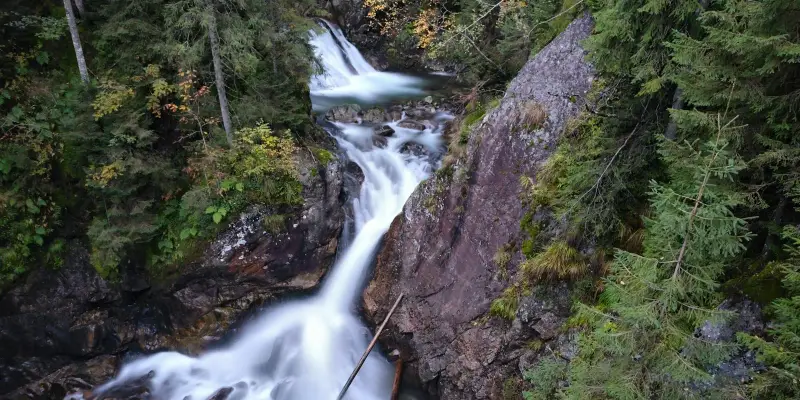
Halfway along there is a stop almost everybody makes without thinking, and it is the right one. The Wodogrzmoty Mickiewicza waterfalls are fed by the Roztoka stream coming down from the Dolina Pięciu Stawów, which makes three main drops and several smaller ones, between 3 and 10 metres high. They used to be called simply “Grzmot”, the thunder, for the roar of water after rain. In 1891 the Tatra Society named them after Adam Mickiewicz, a year after his remains were moved to Wawel Cathedral, although the poet had no connection with the Tatras. The stone bridge on the road, built in 1900 and widened in 1966, gives the best view of the middle drop.
From the bridge the lake is about 1 h 30 min on foot, while the way back to the car parks takes around 40 minutes. A useful detail: after rainy days the roar is far louder, so even those short of time get a small reward here.
The lake, the Old Hut and the loop around the shore
Morskie Oko lies at 1,395 m in the Rybi Potok valley, beneath the Mięguszowieckie Szczyty peaks. It covers roughly 35 hectares and reaches a maximum depth of 50.8 m, which explains the deep colour of the water. The walk around the lake takes about 50 minutes and lets you see the rock wall from different angles. The shore opposite the hut gives the most photographed view, but the quieter one is on the far side.
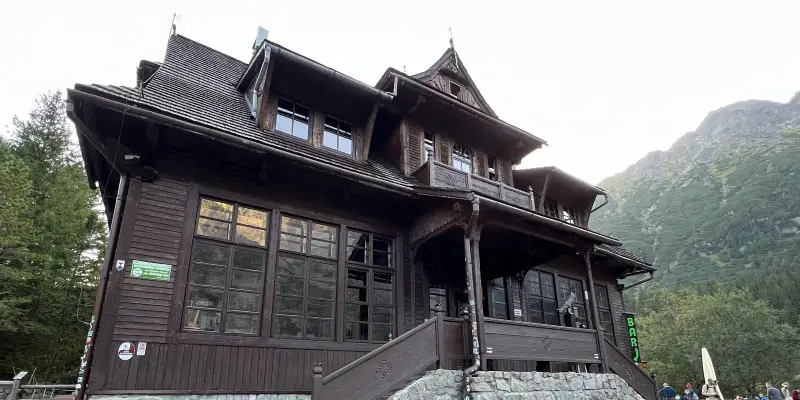
On the moraine, at about 1,405 m, stands the PTTK mountain hut named after Stanisław Staszic, one of the best known in the Tatras. The story begins in 1827, when Emanuel Homolacs built a first shelter with a hall, a kitchen, a log room for sleeping and an attic, with no glass in the windows. The complex burned down several times. After the fire of 1898 the carriage shed, built next door in 1891, took over: it is today's Old Hut, the oldest one still standing in the Polish Tatras. The New Hut followed in 1908. There is also a TOPR mountain rescue station here, and Pope John Paul II visited in 1997. Sitting down with a hot drink and looking at the lake is part of the ritual, though the dining room fills up in the middle of the day.
Beating the crowds without gimmicks
The rule is simple: start early. On fine days the crowds are huge, and those who arrive late find a packed road and a lake turned into a meeting place. A weekday outside school holidays is the best bet; a weekend in August is when the walk risks disappointing. Weather matters too: an overcast day drains colour from the lake, but it also removes half the people, and low cloud among the peaks has a charm of its own.
A few practical tips: bring a windproof jacket even in summer, because wind at the lake changes the temperature quickly; wear walking shoes rather than city ones, since 8.5 km of asphalt is harder than it sounds; and carry water and something to eat. Remember that swimming is forbidden in the park's lakes and streams, and that walking in the park at night is not allowed. Plan your return with a comfortable margin of daylight.
Beyond the lake: Czarny Staw and Rysy
From the hut a route also climbs to Czarny Staw, the black lake sitting higher up in a rock amphitheatre, and on towards Rysy. That is a different story from the paved road: a real mountain trail, to be tackled with proper gear, a checked forecast and up-to-date information on the spot, because conditions change through the season and snow lingers at altitude. For a first visit, the best choice is often to stop at the lake, walk around it and head back unhurried, leaving the rest for another day.
Morskie Oko is no secret and does not pretend to be one. It works like a great mountain living room: you go for its fame, and you stay because the wall, mirrored in the water, holds even the hurried in place. In an emergency in the mountains the number is 112, or the mountain rescue service TOPR on 985.
Frequently asked questions
Where do you park for Morskie Oko?
You park at Palenica Białczańska, the starting point of the road to the lake. On fine days the car park fills early, so arrive in the morning and ask on the spot about parking arrangements.
Is Morskie Oko suitable for children and older visitors?
Usually yes, since the road is wide and gently sloped, but it is 8.5 km each way. With small children or people who are not fit, start early, plan breaks and consider a horse-drawn cart for part of the distance.
Is there food at the hut by the lake?
The PTTK hut has a restaurant where you can sit with a hot drink or a simple meal, but it is very full in the middle of the day. Bringing some food from home avoids waiting on peak days.
How long does the whole trip take?
Plan a full day: the walk is long and stops at the waterfalls, the lake and the hut add up. Walking in the park at night is not allowed, so arrange your return with plenty of daylight to spare.