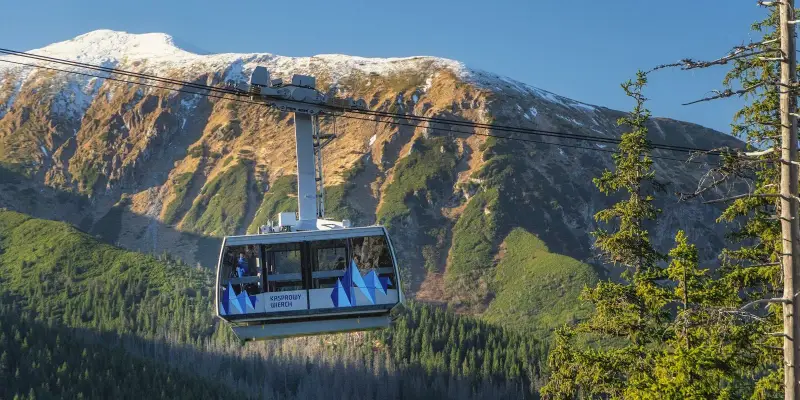
The Kasprowy Wierch cable car was built in 227 days, when the plans had allowed seven months. When the first passengers rode up on 15 March 1936 it was the first installation of its kind in Poland and the sixtieth in the world. Materials came up on horse-drawn carts and on workers' backs, and the workforce eventually reached about a thousand, while naturalists protested against the whole project. Today, in the upper station, you can still see a Polish coat of arms in Art Deco style from that era: a small reminder that the mountain was something the country took pride in.
From Kuźnice to the upper station by cabin
The line starts at Kuźnice, on the edge of Zakopane, stops at Myślenickie Turnie and reaches the upper station at about 1,959 m, 26 metres below the summit. Over 4.25 km it climbs 936 m, and the scenery changes within minutes: from conifer forest to dwarf pine, then to rock and alpine grass. For many it is the easiest way to get the Tatras under your feet without a full day of walking, which is also why the queue at the bottom can be long on sunny days.
One thing to know: the cable car delivers a change of climate in minutes. You set off in a T-shirt and arrive to wind and much lower temperatures, even in summer. Carrying a warm, windproof layer is not excessive caution; it is the reason some people stay up for a quarter of an hour and others for a full hour.
The summit on the border, with its observatory
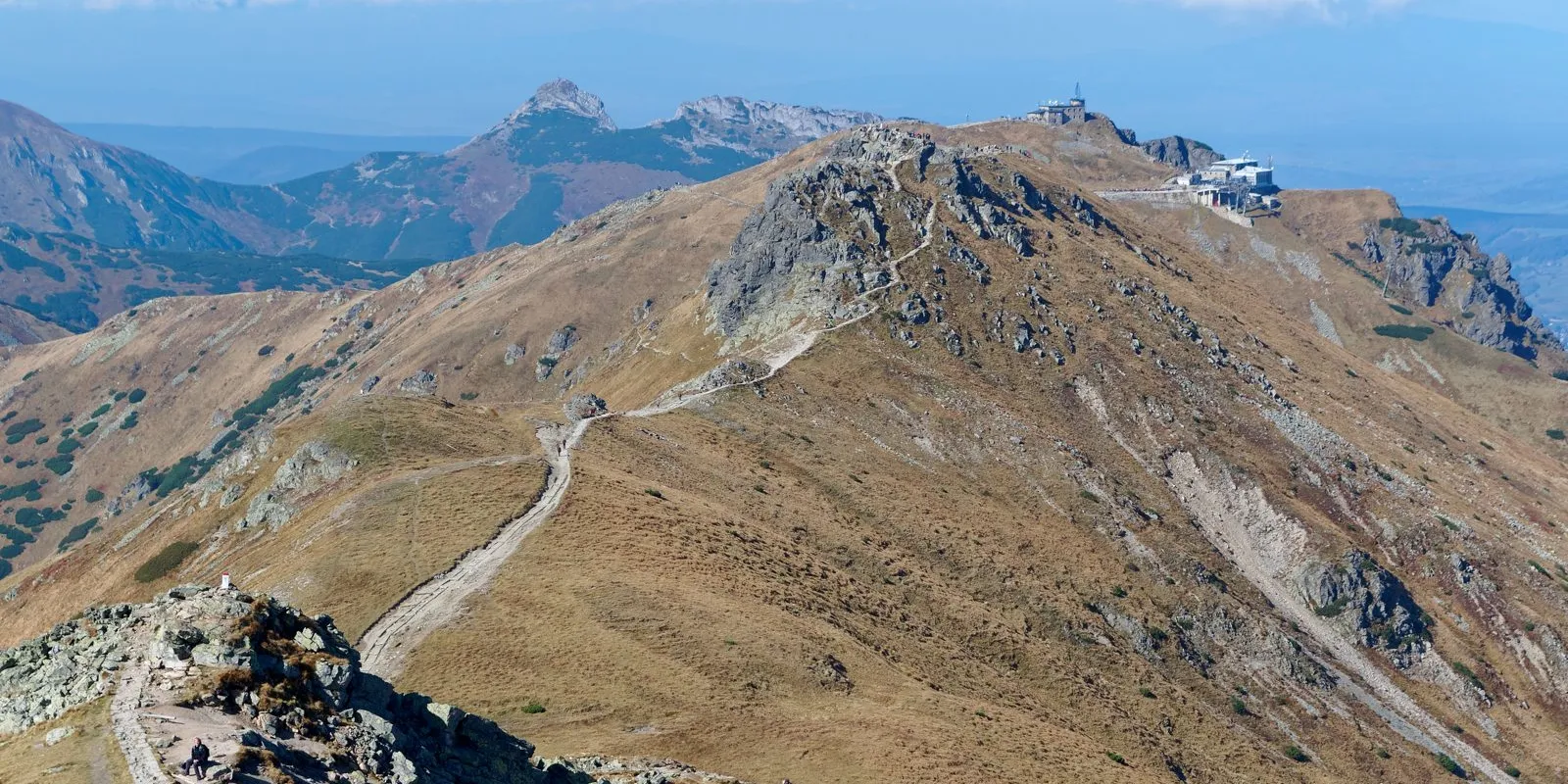
Kasprowy Wierch stands 1,987 m high on the main ridge of the Tatras, right on the border between Poland and Slovakia. The southern slope looks down on the Cicha Valley, in Slovakia: standing there you take in two countries at a glance. On the summit there is a weather observatory run by IMGW, completed in 1938 to a design by Aleksander and Anna Kodelski.
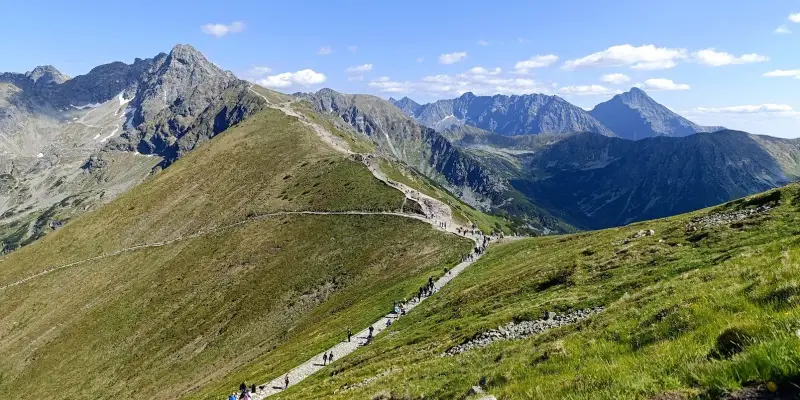
Several trails meet here, and the red one continues over the top towards Świnica, an invitation for the fit, but also a temptation to resist if you rode up in light shoes. The view from this altitude is broad, and on clear days the sequence of ridges and valleys reads like a map. In fog or low cloud, though, the view can vanish altogether: check the forecast before deciding to go up, because conditions at the top change fast.
Walking down: Hala Gąsienicowa
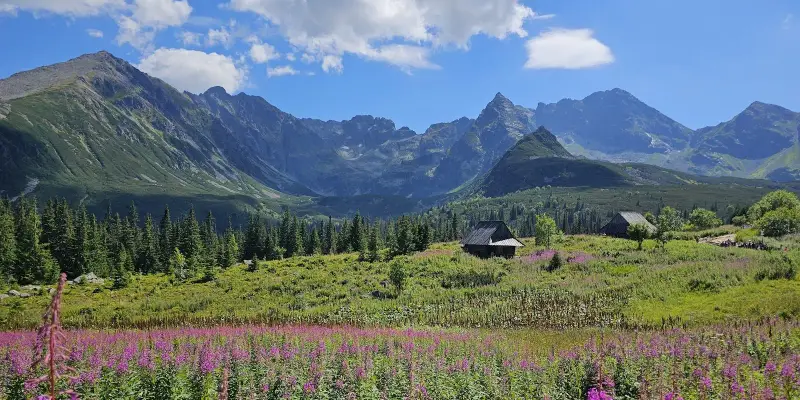
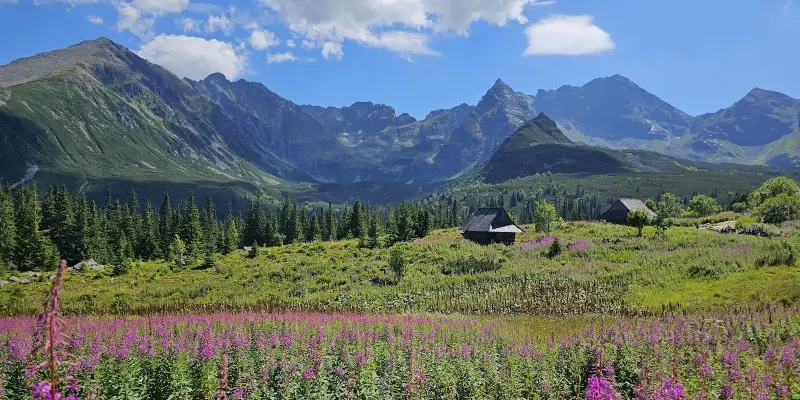
The best choice, for those with legs and time, is to ride up and walk down by way of Hala Gąsienicowa. For centuries it was a great sheep pasture: the alpine grazing area covered roughly 797 hectares, most of it unusable ground, and in 1961 the state bought land that had 381 owners. Today the scene is dominated by the Murowaniec hut, a large and very popular PTTK refuge.
From here you can go to Czarny Staw Gąsienicowy, a goal suitable for beginners and the starting point for Zawrat and Kościelec; harder routes lead to Karb and the Granaty. From the hala down to Kuźnice you follow the blue trail, which goes via Boczań, or the yellow one, which goes via the Jaworzynka valley and takes about the same time: the two join at Przełęcz między Kopami. The reward of the descent is the landscape opening onto the pastures, and it is the part of the day many people remember best.
An honest piece of advice: walking down needs good knees and proper shoes, and it is not a city stroll. If in doubt, take the cable car down and walk up to Hala Gąsienicowa another day, starting from the bottom.
What to bring and when to go
The ideal day starts early, with a stable sky and a clear plan B. A short list of what you really need:
- walking shoes with a good sole, even if you ride up;
- a windproof jacket and a warm layer, also in summer;
- water and something to eat;
- a map or the trail app downloaded, because signal can be missing.
Out of season and with snow the routes call for winter equipment, and conditions at the top change from day to day: ask on the spot before setting out. In winter Kasprowy Wierch is a ski area with two steep runs, the Goryczkowa and the Gąsienicowa, for expert skiers, and in snowy periods you should check the avalanche risk on lawiny.topr.pl. Dogs are not allowed on the national park trails.
Who it is for, and who it is not
Kasprowy Wierch is for anyone who wants a high-mountain panorama with moderate effort, for families who want to stand on a real border ridge, and for walkers who want a traverse without the initial climb. It disappoints those who expect solitude in the middle of August, when the lift runs at full capacity and the top is a coming and going of people. Better the early hours, or a mid-season day with stable weather.
It is neither the highest nor the harshest mountain in the Tatras, but probably the easiest to read: a historic cable car, a summit with two countries in view, a pasture that fed sheep for centuries. Whether the memories of the trip are good will almost always depend on one decision made in the morning, under the sky.
Frequently asked questions
How long does the cable car ride take?
The line covers 4.25 km with an intermediate stop at Myślenickie Turnie, and the journey takes just minutes per section. What matters most is the wait at the bottom on sunny days: starting early shortens it a lot.
Can you walk up from Kuźnice instead of taking the cable car?
Yes, you can walk up from Kuźnice, but it is a proper mountain day, needing suitable shoes and a checked forecast. Out of season and with snow you need winter equipment, and dogs are not allowed on the park trails.
Can you see Slovakia and the Cicha Valley from the top?
Yes, from the summit the southern slope looks down on the Cicha Valley in Slovakia, when cloud allows. The best view comes with a clear sky; if the valley is misty it is better to postpone the ride.
What is there to do on Kasprowy Wierch in winter?
In winter the mountain is a ski area, with two steep runs, the Goryczkowa and the Gąsienicowa, for expert skiers. For walking you need winter equipment and attention to avalanche risk, which can be checked on lawiny.topr.pl.