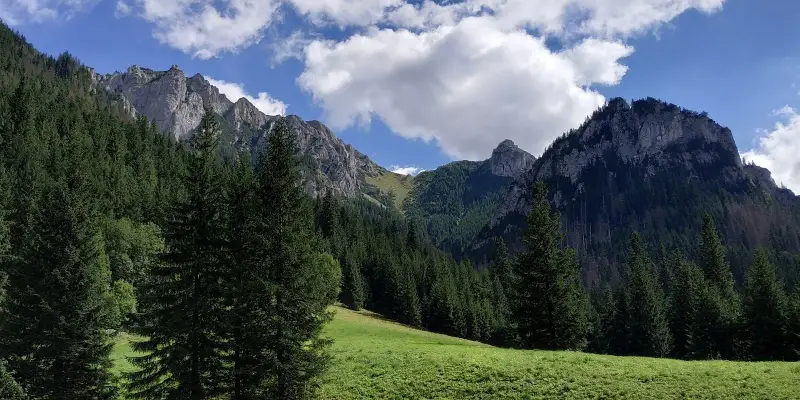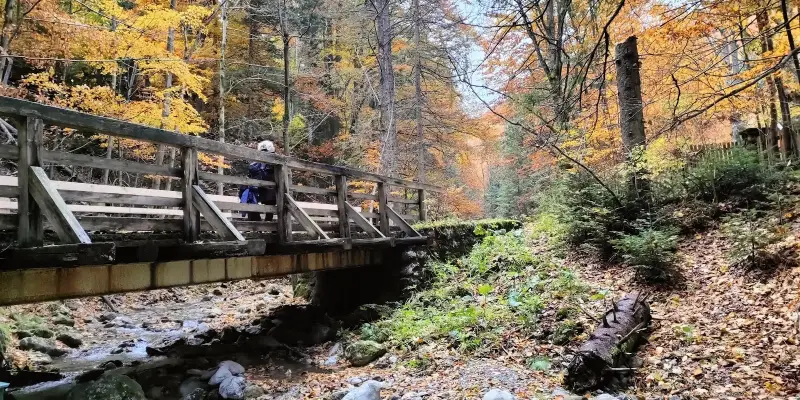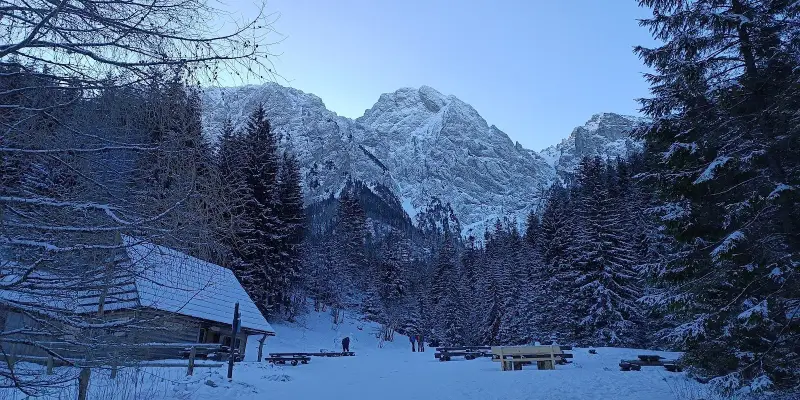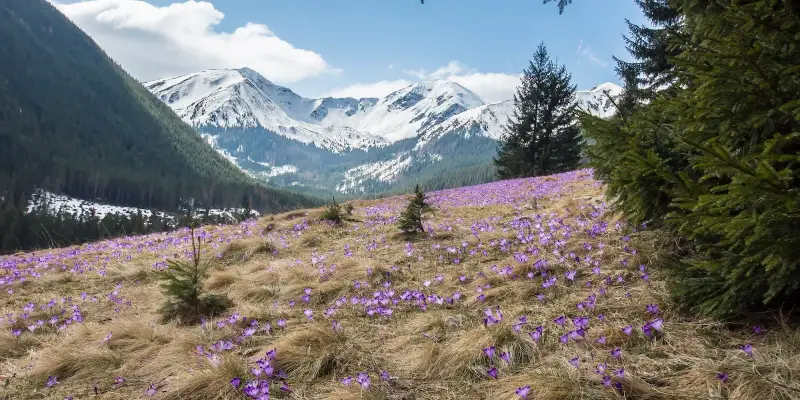
Under the meadows of the Kościeliska Valley lies a labyrinth that nobody has ever finished exploring. Among the caves open to visitors are Mroźna, Smocza Jama, Mylna, Raptawicka and Obłazkowa, but hundreds more remain closed to the public: the valley holds the greatest concentration of caves in the Polish Tatras. The paradox is that on the surface everything looks simple, a broad valley floor, a stream, a forest, and that this simplicity is what makes it one of the best outings for people with little mountain experience.
A long valley with no cars
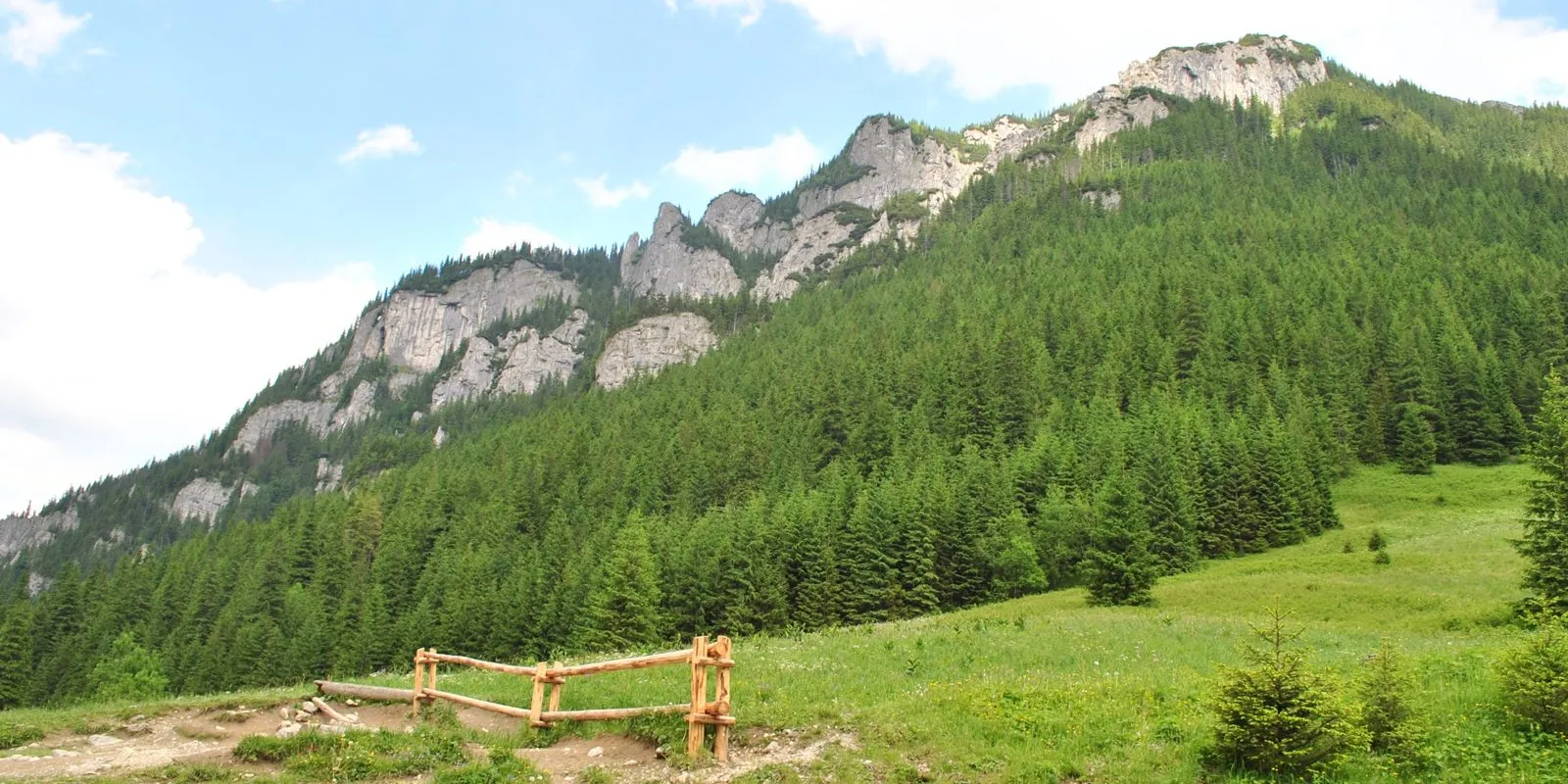
The Kościeliska is about 9 km long and, at roughly 35 km², is the second-largest valley in the Polish Tatras after the Chochołowska. The first thing you notice is the quiet: cars and bicycles are banned, and in summer you move on foot or by horse-drawn cart, while in winter sleighs replace the carts. What remains is the sound of water and footsteps, and the walk finds its rhythm at once.
You set off from the car park at Kiry. From there to the Hala Ornak hut is 5.5 km, about 1 h 30 min on foot: a wide, well-kept road with a gentle gradient, suitable for families and beginners. That does not make it trivial. Conditions change with the season and the weather, and it is wise to ask on the spot before setting out, especially outside summer.
Polana Pisana and the Kraków Gorge
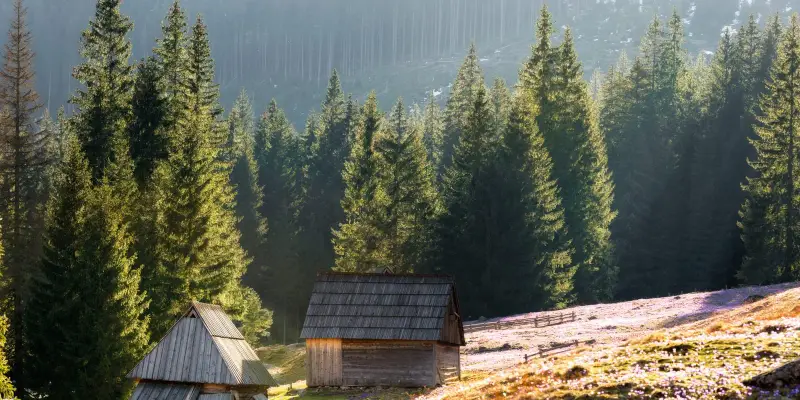
Along the valley floor you come to Polana Pisana, a clearing with tables and benches where the horse-drawn carts stop. It is where many people decide what to do with the rest of the day, and the best place to eat whatever you have brought. From here a route branches off to the Wąwóz Kraków, a narrow gorge between rock walls, followed on the yellow trail, one-way, in about 50 minutes.
The Wąwóz Kraków is the most striking part of the valley, and also the one where you need to watch your footing: wet rock, steps, tight sections. It is not a place to hurry through, nor to wear city shoes. The trails are marked for a reason, and leaving them for a photograph is never worth it.
The caves: what to bring and what to expect
The open caves are the reason the valley is famous, and each has its own character. Mroźna has a name that promises cold, “frosty”: inside the caves the air stays cool even in high summer. The Smocza Jama, the “dragon's den”, has a name that makes children smile at once. Mylna, Raptawicka and Obłazkowa complete the list of accessible ones.
To visit them you need a torch and suitable shoes, because the ground is damp and uneven. Do not mistake the caves for an indoor stroll: they are natural cavities with low passages and slippery floors. Anyone who suffers from claustrophobia should stay outside and enjoy the valley. Ask on the spot which caves can be visited on the day, because conditions and access rules can change.
Hala Ornak and the Smreczyński Staw pond
Further up the valley stands the Hala Ornak PTTK hut, at about 1,100 m. It is the classic goal for a full day out: you arrive, sit, rest, and set off again without hurry. For those with energy left, from the junction you reach the Smreczyński Staw in about 30 minutes, a small glacial pond, quiet and far from the crowds of the better-known destinations.
This is a valley that lets you choose the length of your day. You can stop at Polana Pisana, do the Wąwóz Kraków, push on to the hut or combine everything with a little cave. A full day is not short, so allow a margin of daylight, because walking in the park at night is not allowed.
Who it is for, who it is not, and when to go
The Kościeliska is for families, beginners and uncertain days: if the weather is wrong for high altitude, the valley floor and the caves remain a good alternative, and even in light rain the forest has its charm. It suits less those who want solitude at midday on a summer Saturday: the valley is very popular, and the best-known caves have queues. The advice is to arrive early, when the car park is still free and the forest nearly empty, or to choose a weekday.
Dogs are not allowed on the national park trails, and it is best to stay on the path and not bivouac. In that spirit the Kościeliska Valley is understood better than it reads: a place that asks for no feats, only attention, and gives back a day rich in small things, the light in the gorge, the cold of the cave, the wooden table at Polana Pisana where you eat with the stream beside you.
Frequently asked questions
Can you visit the valley in the rain?
Yes, the valley floor is walkable in light rain, but you need a waterproof jacket and shoes with a good sole. Wet rock makes the gorge and cave entrances slippery, so check the forecast and skip the damper stretches if the weather worsens.
Do you need a torch for the caves?
Yes, bring a torch and suitable shoes, because the ground inside is damp and uneven. A warm layer helps too: the air inside the caves stays cool even in summer.
Where can you eat and rest along the route?
At Polana Pisana there are tables and benches in a clearing, ideal for a packed lunch. Further on, at about 1,100 m, the Hala Ornak PTTK hut is the classic place for a break.
Is the Kraków Gorge suitable for children?
Often yes, if they walk regularly, since it takes about 50 minutes, but it has steps, tight sections and damp rock. Hold small children's hands on the steeper passages and ask on the spot about the state of the trail before going in.