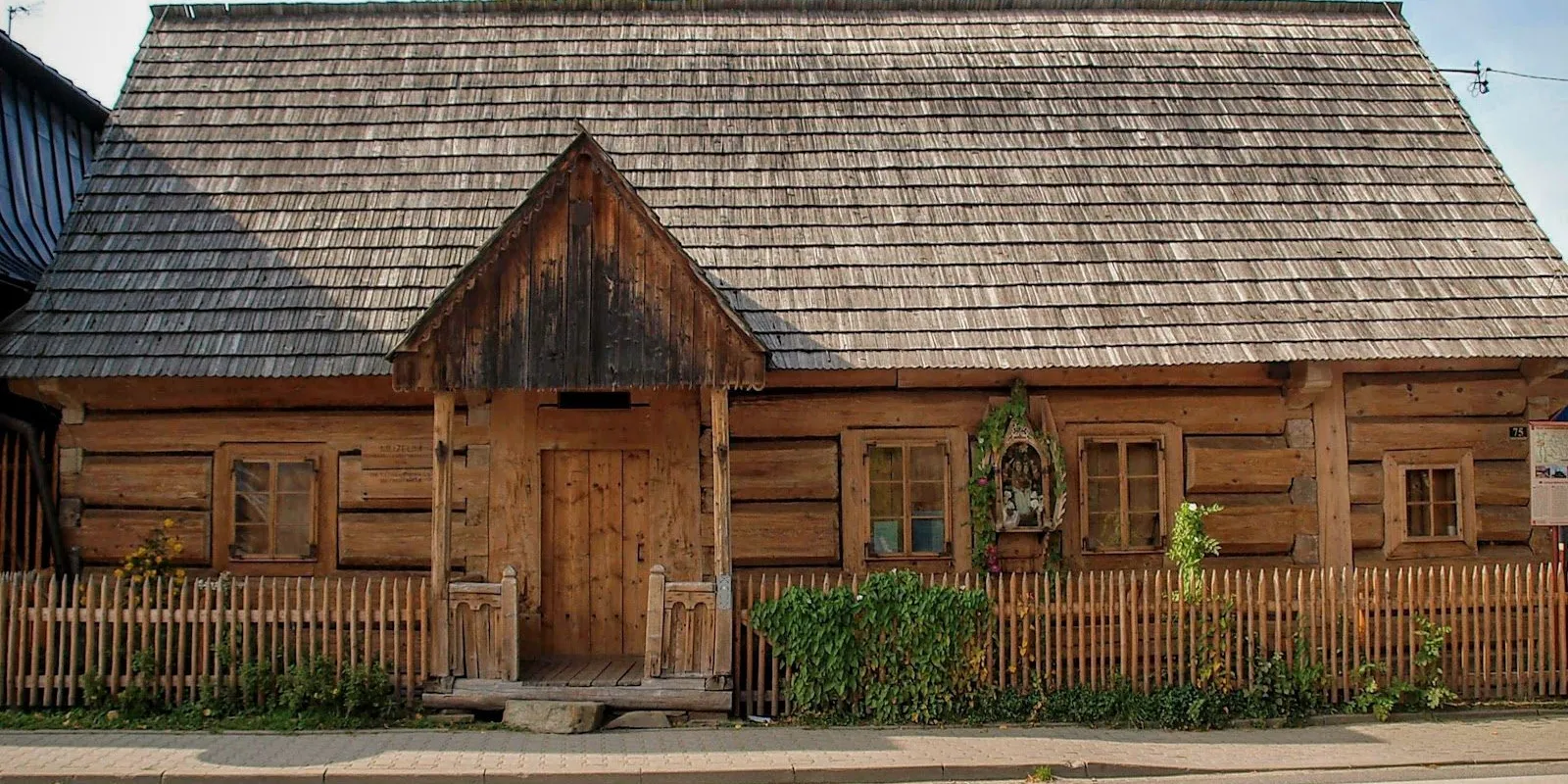
The log house where the 1846 uprising was declared
Chochołów has a single street, and almost every house along it is built of logs: more than a hundred buildings are entered in the village's register of monuments, and every year, before Easter, the wooden walls are scrubbed with soapy water. At number 75 stands the Bafia family cottage, where since 1978 a branch of the Tatra Museum has told the story of the 1846 uprising.
A royal village strung along one road
The village dates from the late sixteenth century and takes its name from Bartłomiej Chochołowski, who was its sołtys, the village head; the founding charter of the royal village dates from 1592. The houses stand with their gable ends to the road and their fronts to the south, and the outbuildings join the dwelling at a right angle, so each farmstead forms an L. Houses like these show where Podhale's timber architecture came from, the tradition Stanisław Witkiewicz looked to when, in Zakopane, he searched for a model for what became the Zakopane Style.
Inside Jan Bafia's house
The cottage belonged to Jan Bafia, a well-off farmer, and is dated to 1798, with a rebuilding in 1889. Its walls are made of logs split lengthways and crossed at the corners, a typical Podhale technique. You enter a vestibule, and from there reach the black room, where everyday life took place, with household utensils and farm tools, and the white room, kept for festive occasions: light walls, decorated furniture, glass paintings and pottery that show the owners' prosperity. Beyond are the bedchamber and, above it, a small storage loft. On the outer wall hangs a little chapel made from the altar of an old wooden church that was dismantled in 1874.
Three days in February 1846
The national government in Kraków had set the start of the uprising for 21 February, but Austrian troops had already entered the city on the 18th and the news did not reach Chochołów in time. The local leaders were the teacher and organist Jan Kanty Andrusikiewicz, the priest Leopold Kmietowicz and Father Michał Głowacki of Poronin. On the evening of the 21st the insurgents disarmed the Austrian frontier guards and declared the revolt, then seized the customs house at Sucha Góra. On the evening of the 22nd about 500 peasants from the neighbouring villages gathered, but around midnight customs guards led by Romuald Fiutowski, helped by villagers from Czarny Dunajec, attacked them: Andrusikiewicz and Kmietowicz were wounded and further resistance was pointless.
About 150 insurgents were arrested and held at Spielberg, Kufstein and Wiśnicz. Kmietowicz was sentenced to death, later commuted to many years in prison; everyone was freed by the revolution of 1848. On the edge of the village a statue of St John of Nepomuk recalls the episode and, by tradition, turns its back on Czarny Dunajec.
What the rooms tell
The historical display lines up the insurgents' weapons, a cartouche with the insurgent calendar, portraits of the leaders, lists of participants and accounts of the reprisals. One chapter covers the commemorations, especially that of 1913, and the final part gathers the scholarly, poetic and prose works inspired by the revolt. A separate corner is devoted to Seweryn Goszczyński, a poet and conspirator linked to the Tetmajer family of Łopuszna: after the November Uprising he lived in hiding, in 1832 he visited Podhale, and in Kraków he founded a secret society that worked in all three partitions of Poland.
The visit is short, but it rewards combining with a walk along the village street: the houses are lived in, so look from the road and do not enter the yards. Because the museum is open only on some days of the week, check the hours before setting out. Chochołów lies about 19 km west of Nowy Targ, close to the Slovak border.
Where it is
Tours and activities
-
 From €22 per person
Zakopane
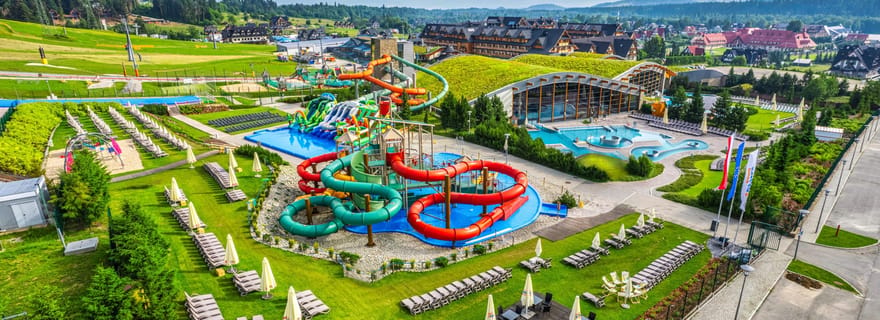
Terma Bania Aquapark Tickets in Białka Tatrzańska
★ 4.6 (132 reviews) · Free cancellation
Duration: 3h30
See availability Details -
 From €5 per person
Zakopane
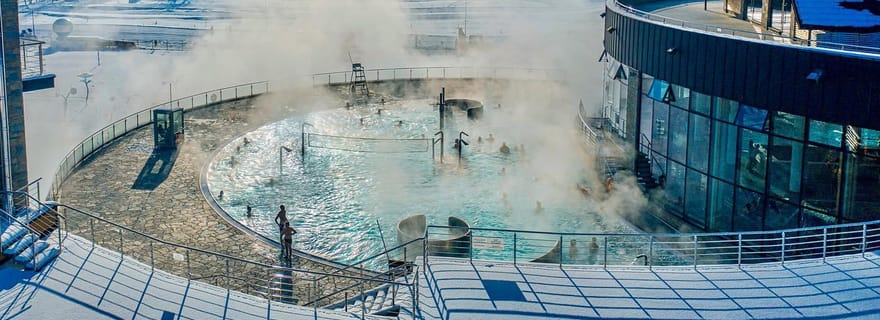
Chochołowskie Thermal Baths Entry with a Personal Host
★ 4.5 (116 reviews) · Free cancellation
Duration: 3–10 h
Guide in:
See availability Details


-
 From €81 per person
Zakopane
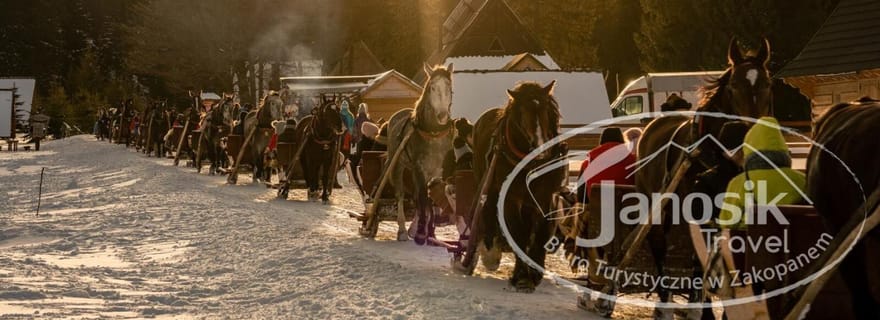
Zakopane: Chochołowska Valley Sleigh Ride with Bonfire
★ 4.4 (58 reviews) · Free cancellation
Duration: 3 h · Hotel pick-up
Guide in:
See availability Details -
 ★ Top rated
From €18 per person
Zakopane
Zakopane and the Tatra Mountains Day Trip from Kraków
★ 4.7 (371 reviews) · Free cancellation
Duration: 5–9 h · Hotel pick-up
Guide in:
See availability Details